Embryo freezing has become an important part of modern IVF. It allows patients to preserve embryos for a future pregnancy, delay embryo transfer when necessary, or potentially try for another child years after their original IVF treatment.
But one question comes up again and again:
How long can frozen embryos actually last?
The answer may be surprising. When embryos are properly frozen and continuously stored under the correct laboratory conditions, there is no established biological “expiration date” after just a few years. Healthy births have been reported using embryos that were frozen for decades.
The bigger considerations are usually storage conditions, clinic policies, local regulations, and how long the patient wishes to continue storage.
Do Embryos Expire?
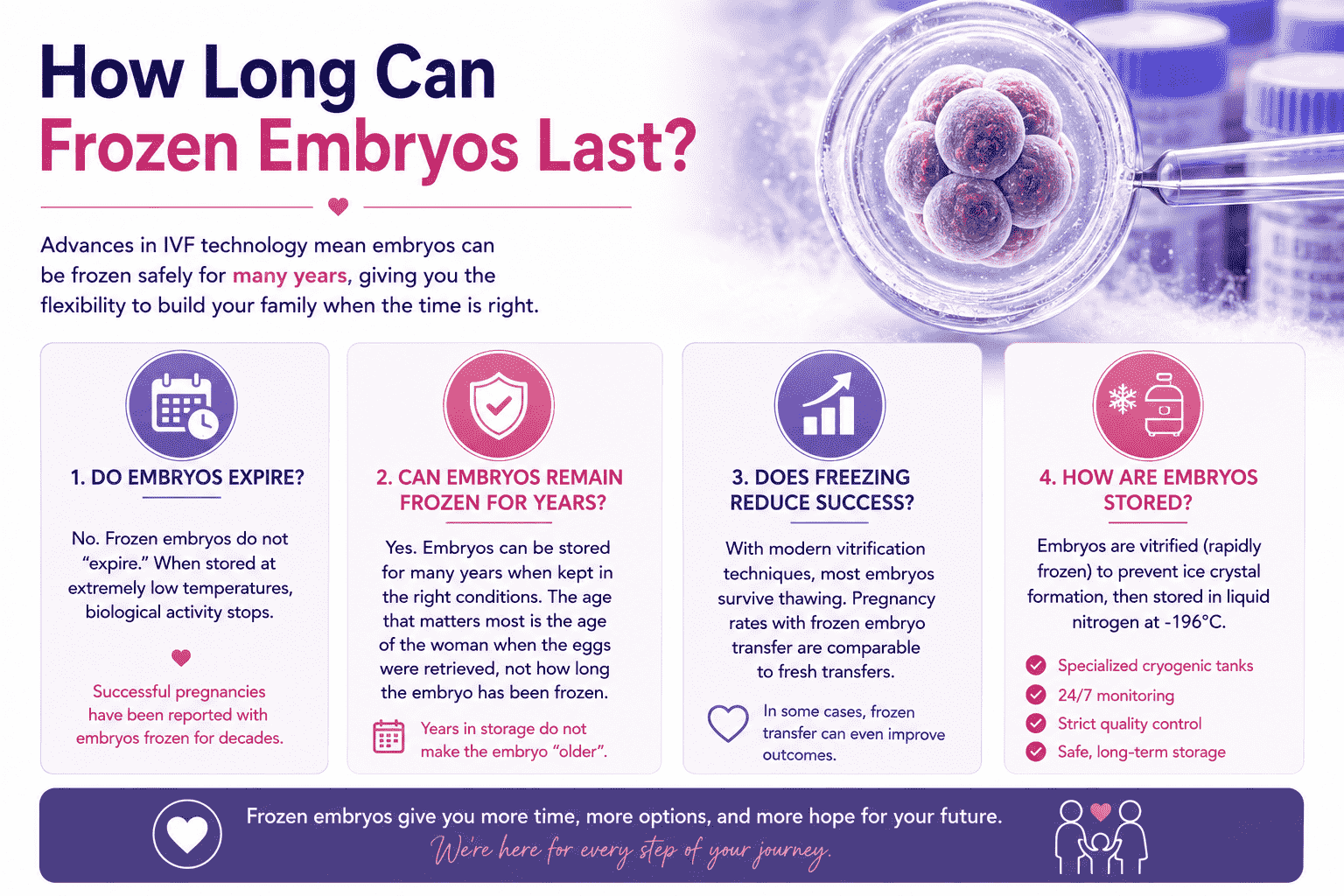
Frozen embryos do not “expire” in the same way that food or medication does.
Modern IVF laboratories commonly use a rapid-freezing technique called vitrification. This brings embryos to extremely low temperatures and essentially pauses biological activity.
While the embryo remains correctly cryopreserved, it does not continue developing or aging in the way it would inside the body.
This means that an embryo stored for several years isn’t biologically several years “older.”
The age that matters most for embryo-related outcomes is generally the age of the woman or egg donor when the eggs were retrieved, rather than how many years the resulting embryo has spent frozen.
There can, however, be legal or administrative limits on embryo storage depending on the country and clinic.
Can Embryos Remain Frozen for Years?
Yes.
Embryos can potentially remain frozen for many years when maintained under appropriate conditions.
There have even been successful pregnancies and healthy births from embryos stored for decades.
This is particularly important for patients who:
- Want another child later
- Need to postpone pregnancy
- Have completed IVF but aren’t ready for transfer
- Want to preserve embryos before certain medical treatments
- Have additional embryos remaining after a successful IVF cycle
For some families, frozen embryos can provide an opportunity to return years later for another pregnancy without repeating the entire ovarian stimulation and egg retrieval process.
How Are Embryos Stored?
After fertilization, embryos are carefully monitored as they develop in the embryology laboratory.
Embryos suitable for freezing are commonly preserved using vitrification.
Instead of slowly freezing the embryo, vitrification cools it extremely rapidly. This helps minimize the formation of damaging ice crystals within the cells.
Once vitrified, embryos are stored in specialized cryogenic tanks containing liquid nitrogen at temperatures of approximately -196°C (-321°F).
The laboratory plays an extremely important role here.
Cryogenic storage systems require careful identification procedures, monitoring, quality control, and protocols designed to keep embryos safely stored over long periods.
When a patient is ready for treatment, the selected embryo is carefully warmed and assessed by the embryology team before transfer.
Does Freezing Reduce IVF Success?
This is one of the biggest concerns patients have about embryo freezing.
With modern vitrification techniques, most suitable embryos survive the freezing and warming process, although no laboratory procedure can guarantee that every embryo will survive.
Importantly, frozen embryo transfer is now a routine part of IVF treatment worldwide.
For many patients, pregnancy rates with frozen embryo transfers can be comparable to fresh transfers. In some circumstances, a fertility specialist may actually prefer a frozen transfer.
This can allow the ovaries and hormone levels to settle after stimulation while the uterus is prepared separately for embryo transfer.
Whether fresh or frozen transfer is preferable depends on the individual patient and treatment cycle.
Does an Embryo Lose Quality While It Is Frozen?
Properly cryopreserved embryos are maintained in a state where biological activity is essentially suspended.
They aren’t continuously growing or aging while in storage.
Therefore, simply keeping an embryo frozen for several years does not mean that it gradually becomes “older” in the same way a person’s eggs naturally age inside the ovaries.
What matters much more is the quality of the embryo when it was frozen and the conditions under which it was frozen, stored, and eventually warmed.
Does My Age Matter When I Use a Frozen Embryo?
Yes—but there is an important distinction.
Imagine a woman creates and freezes embryos at age 30 and returns to use one at age 38.
The embryo was created from eggs retrieved when she was 30. Therefore, many embryo-related risks are more closely associated with her age at egg retrieval.
However, her health and age at the time of pregnancy still matter.
Pregnancy itself can carry additional risks as maternal age increases, so a medical evaluation may be recommended before embryo transfer.
Why Do IVF Clinics Freeze Embryos?
There are many reasons embryos may be frozen rather than transferred immediately.
These include:
- Additional good-quality embryos remaining after IVF
- Planning a frozen embryo transfer
- Genetic testing such as PGT
- Concerns about ovarian hyperstimulation syndrome (OHSS)
- The uterine lining not being ready for transfer
- Fertility preservation
- Planning future pregnancies
Embryo freezing gives fertility specialists and patients greater flexibility when planning treatment.
What Happens When You’re Ready to Use a Frozen Embryo?
When you’re ready for a frozen embryo transfer, your fertility team will first prepare and evaluate the uterus.
The uterine lining may be prepared through a natural cycle or with medication, depending on the patient’s circumstances.
The embryo is then warmed in the laboratory.
Embryologists check that it has survived the warming process and assess its condition before transfer.
The embryo is then placed directly into the uterus using a thin catheter.
From that point onward, implantation occurs in essentially the same way as with an embryo transferred during a fresh IVF cycle.
Can Frozen Embryos Be Used for Another Baby Years Later?
Yes.
This is one of the major advantages of embryo freezing.
A couple may complete IVF, have their first child, and keep additional embryos frozen.
Several years later, they may return to use one of those embryos in an attempt to have another child.
Because the embryos were created during the original IVF cycle, the eggs used to create them remain associated with the woman’s age at the time they were retrieved.
This can make embryo freezing particularly valuable for family planning.
Final Thoughts
So, how long can frozen embryos last?
Frozen embryos may last for many years—and even decades—when they are properly vitrified and continuously maintained under appropriate cryogenic storage conditions.
Embryos do not simply become too old because they have spent several years frozen. Modern vitrification essentially pauses their biological development until they are warmed for treatment.
What matters most is the quality of the embryo when it was created, the expertise of the embryology laboratory, proper long-term storage, and careful warming before transfer.
If you have frozen embryos or are considering embryo freezing, speak with your fertility clinic about its storage procedures, fees, consent requirements, and any legal storage limits that apply where your embryos are kept.
Embryo freezing isn’t simply about preserving an embryo today. For many families, it preserves an opportunity they may choose to return to years into the future.
For any of your fertility problems, please do not hesitate to contact us. At Fertility Solutions we pride ourselves with the excellent tailored personal care we provide to our patients for their specific needs. A team member will contact you as soon as we get your message, and construct a personal treatment plan for your fertility problems in the country of Cyprus. You can also contact our clinics directly through the links below.
Get in Touch with Our Clinics:
Cyprus Crown IVF Contact: https://en.cypruscrownivf.com/contact
Cyprus American IVF Contact: https://www.cyprusamericanivf.com/contact-us/
Dr. Halil Ibrahim Tekin (Dr. HIT) Youtube: https://www.youtube.com/@dr.halilibrahimtekin1715
Cyprus American IVF Youtube: https://www.youtube.com/@AmerikanTupBebekMerkezi
Clavis Fertility Centre: https://www.clavisfertilitycenter.com