There is a chance that PGT-A can show no normal embryos. Going through IVF and reaching the blastocyst stage can already feel like a major achievement. So when PGT-A results come back showing no chromosomally normal—or euploid—embryos, it can be incredibly disappointing.
For many patients, the immediate question is:
“Does this mean I can’t have a healthy baby with my own eggs?”
Not necessarily.
One IVF cycle represents one group of eggs and embryos. Results can vary between cycles, and factors such as maternal age, the number of embryos tested and individual biology can have a major influence on the outcome.
Depending on your situation, another egg retrieval may be worth considering. In some cases, a mosaic embryo may also be discussed with your fertility specialist and genetic counselor.
Let’s look at what these results actually mean.
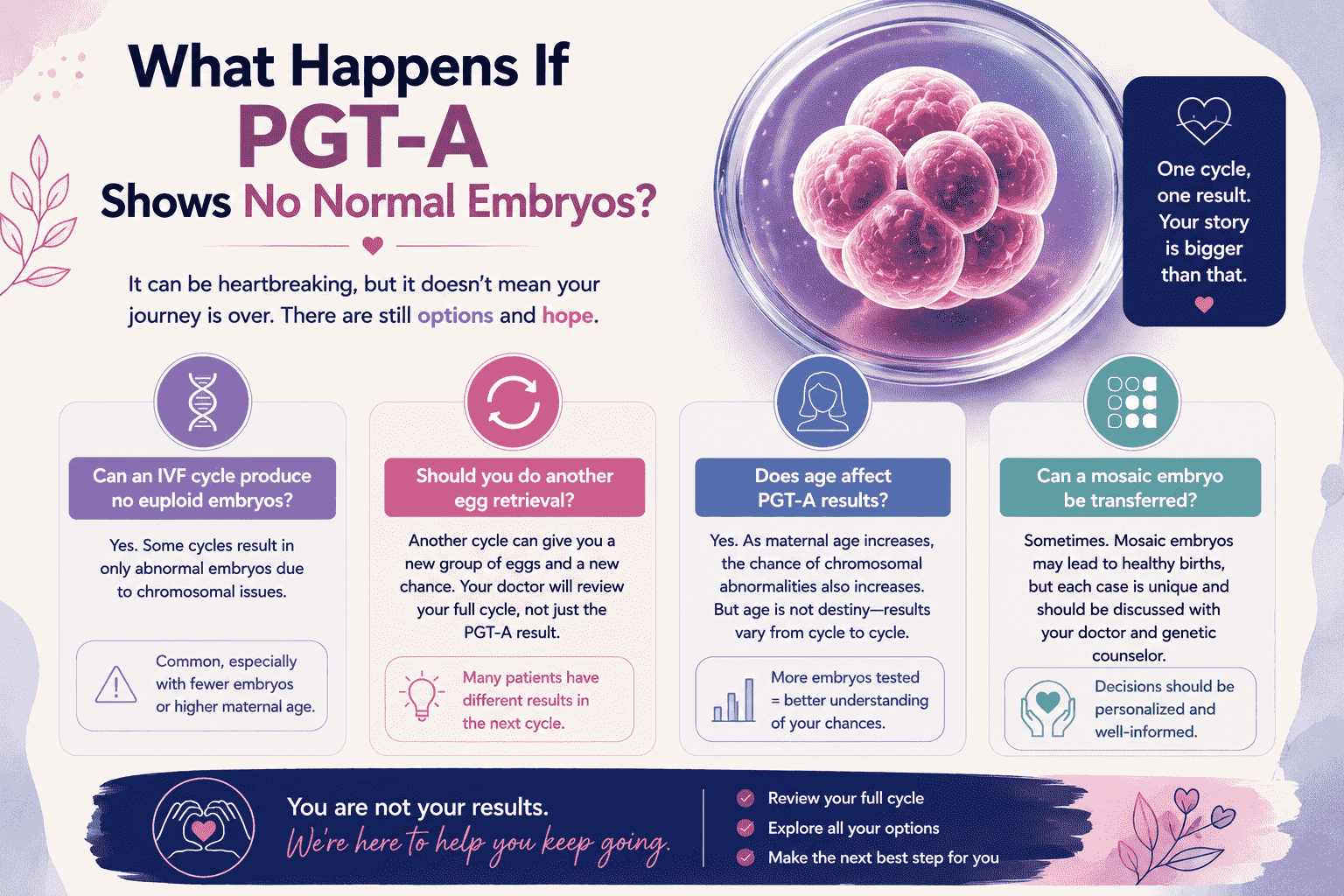
Can an IVF Cycle Produce No Euploid Embryos?
Yes.
PGT-A, or Preimplantation Genetic Testing for Aneuploidy, examines cells biopsied from an embryo to assess whether they contain the expected number of chromosomes.
An embryo reported as euploid has the expected chromosome number.
An embryo reported as aneuploid has a chromosome abnormality detected by the test.
It is possible for every embryo tested during one IVF cycle to be reported as aneuploid.
This can be particularly upsetting when several embryos successfully reached the blastocyst stage and appeared healthy under the microscope.
However, embryo appearance and chromosome results are two different things.
A beautiful-looking blastocyst can still be chromosomally abnormal, while morphology alone cannot reliably tell embryologists whether an embryo is euploid.
The chances of having no euploid embryos are influenced by several factors, especially:
- Maternal age
- Number of embryos available for testing
- Egg quality
- Individual reproductive history
- Biological variation between cycles
Having no euploid embryos in one cycle therefore does not automatically mean the same result will occur in every future cycle.
Does Age Affect PGT-A Results?
Yes. Maternal age is one of the strongest factors affecting the likelihood of embryo aneuploidy.
Women are born with their lifetime supply of eggs. As reproductive age increases, errors during chromosome separation become more common.
As a result, the proportion of embryos with chromosome abnormalities generally increases with maternal age.
This helps explain why a woman in her early 30s may have a different proportion of euploid embryos than a woman in her early or mid-40s, even if both produce a similar number of blastocysts.
But age provides probabilities—not guarantees.
Two women of exactly the same age can receive very different PGT-A results.
The number of embryos tested also matters.
If only one or two embryos are available, it is entirely possible for neither to be euploid simply because the sample is so small.
Should You Do Another Egg Retrieval?
For many patients, another egg retrieval may be worth discussing.
One IVF cycle does not necessarily predict the outcome of the next cycle.
A second retrieval provides another group of eggs and therefore another opportunity to create embryos.
Whether another cycle makes sense depends on factors such as:
- Your age
- AMH and ovarian reserve
- Number of eggs retrieved previously
- Number of mature eggs
- Fertilization rate
- Number of blastocysts produced
- Previous PGT-A results
- Your overall fertility history
Your doctor should review the entire previous cycle rather than looking only at the final PGT-A report.
For example, if many eggs were retrieved but very few reached blastocyst, that tells the fertility team something different from a cycle in which several strong blastocysts were created but all tested aneuploid.
These details can help determine whether changes to the treatment strategy should be considered.
Can a Mosaic Embryo Be Transferred?
Sometimes.
PGT-A results aren’t always simply “normal” or “abnormal.”
Some embryos may be reported as mosaic.
A mosaic result means the biopsy sample contained a mixture of cells with apparently normal and abnormal chromosome findings.
Certain mosaic embryos have resulted in healthy pregnancies and births. However, their implantation potential and reproductive risks can differ depending on the specific mosaic finding.
A mosaic embryo should therefore not automatically be treated the same way as a fully euploid embryo.
If no euploid embryos are available, your fertility specialist may discuss whether a particular mosaic embryo could potentially be considered for transfer.
This decision should involve careful review of:
- The specific chromosome involved
- The type and level of mosaicism reported
- The laboratory report
- Other embryos available
- Your medical and fertility history
Genetic counseling is particularly important before considering mosaic embryo transfer.
If pregnancy occurs following transfer of a mosaic embryo, prenatal diagnostic testing may also be discussed.
Does an Abnormal PGT-A Result Mean the Embryo Could Never Become a Healthy Baby?
This is where the conversation becomes more complicated.
PGT-A is a screening test, not a perfect diagnostic test of every cell within an embryo.
Only a small sample of cells from the embryo’s trophectoderm—the part that contributes largely to the placenta—is biopsied.
The test provides valuable information about the chromosome status of those sampled cells, but it does not examine every cell in the embryo.
For this reason, PGT-A results should always be interpreted alongside the laboratory report, clinical history and professional genetic counseling.
Patients should not make decisions about embryos based solely on information found online.
What If Repeated IVF Cycles Produce No Euploid Embryos?
If several cycles repeatedly produce no euploid embryos, your fertility specialist may recommend reviewing the overall treatment strategy.
Depending on age, ovarian reserve and previous results, possibilities may include:
- Another IVF cycle with your own eggs
- Changes to ovarian stimulation
- Further investigation where clinically appropriate
- A tandem cycle
- Egg donation
A tandem cycle may be particularly relevant for patients who still want an opportunity to use their own eggs but are concerned about repeatedly producing abnormal embryos.
This approach can involve using the patient’s own eggs alongside donor eggs within the broader treatment cycle, providing another potential pathway if embryos created from the patient’s eggs are unsuccessful.
For some patients—particularly where maternal age and repeated abnormal embryo results are major concerns—egg donation may provide a substantially different probability of obtaining chromosomally healthy embryos because chromosome risk is closely associated with the age of the egg.
But this is a highly personal decision.
There is no point at which every patient should automatically move to donor eggs.
Does Having No Normal Embryos Mean IVF Has Failed?
It can certainly feel that way, but clinically, the cycle has also provided valuable information.
Your fertility team now knows more about:
- How your ovaries responded to stimulation
- How many eggs matured
- How fertilization progressed
- How embryos developed
- How many reached blastocyst
- What the PGT-A results showed
That information can help shape the next treatment decision.
Sometimes another retrieval produces a different result.
Sometimes the previous cycle highlights an area that should be investigated further.
And sometimes the results help patients and their doctors decide that a different pathway—such as tandem treatment or egg donation—may offer a better chance of success.
Final Thoughts
Receiving a PGT-A report showing no euploid embryos can be one of the most difficult moments in IVF.
But one result does not necessarily define your entire fertility journey.
Maternal age, the number of embryos tested, egg quality and natural biological variation can all influence PGT-A results. Another egg retrieval may produce a different group of embryos and potentially a different outcome.
And if a mosaic embryo is available, it may deserve a more detailed conversation rather than being automatically dismissed, depending on the specific result.
The most important next step is to sit down with your fertility specialist and carefully review what happened throughout the entire IVF cycle—not only the final PGT-A result.
Sometimes the next decision is another retrieval. Sometimes it’s further evaluation. And sometimes it’s considering a different route altogether.
The goal isn’t simply to produce as many embryos as possible.
It’s to find the safest and most appropriate path toward a healthy pregnancy.
For any of your fertility problems, please do not hesitate to contact us. At Fertility Solutions we pride ourselves with the excellent tailored personal care we provide to our patients for their specific needs. A team member will contact you as soon as we get your message, and construct a personal treatment plan for your fertility problems in the country of Cyprus. You can also contact our clinics directly through the links below.
Get in Touch with Our Clinics:
Cyprus Crown IVF Contact: https://en.cypruscrownivf.com/contact
Cyprus American IVF Contact: https://www.cyprusamericanivf.com/contact-us/
Dr. Halil Ibrahim Tekin (Dr. HIT) Youtube: https://www.youtube.com/@dr.halilibrahimtekin1715
Cyprus American IVF Youtube: https://www.youtube.com/@AmerikanTupBebekMerkezi
Clavis Fertility Centre: https://www.clavisfertilitycenter.com