What determines a good number of blastocysts after having your egg collection procedure. You may start an IVF cycle with 10 eggs, see several fertilize successfully, and then discover that only two or three embryos reached the blastocyst stage.
For many patients, this comes as a shock.
Where did all the other embryos go? Is two blastocysts enough? Should I have produced more?
One of the most important things to understand about IVF is that not every egg retrieved will become a blastocyst. There is a natural process of attrition at every stage—from egg retrieval and maturity to fertilization and embryo development.
And when it comes to blastocysts, there isn’t one number that defines a “good” IVF cycle.
Your age, egg quality, sperm quality, number of mature eggs and embryo development can all influence the final result.
Let’s look at what actually happens.
What Is a Blastocyst?
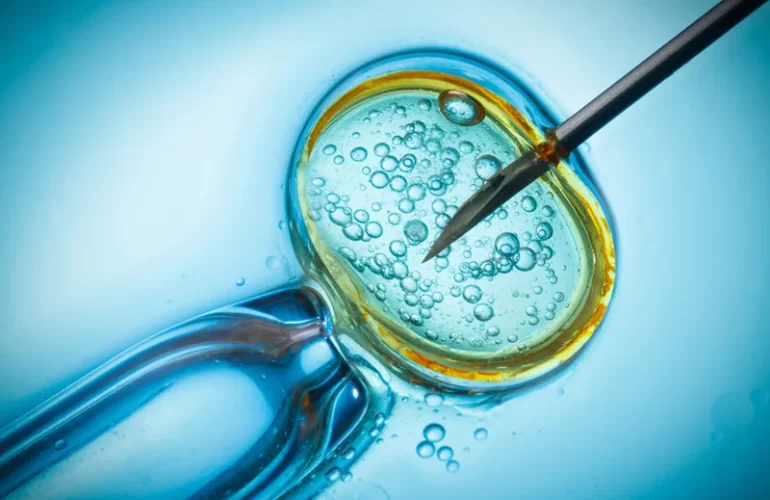
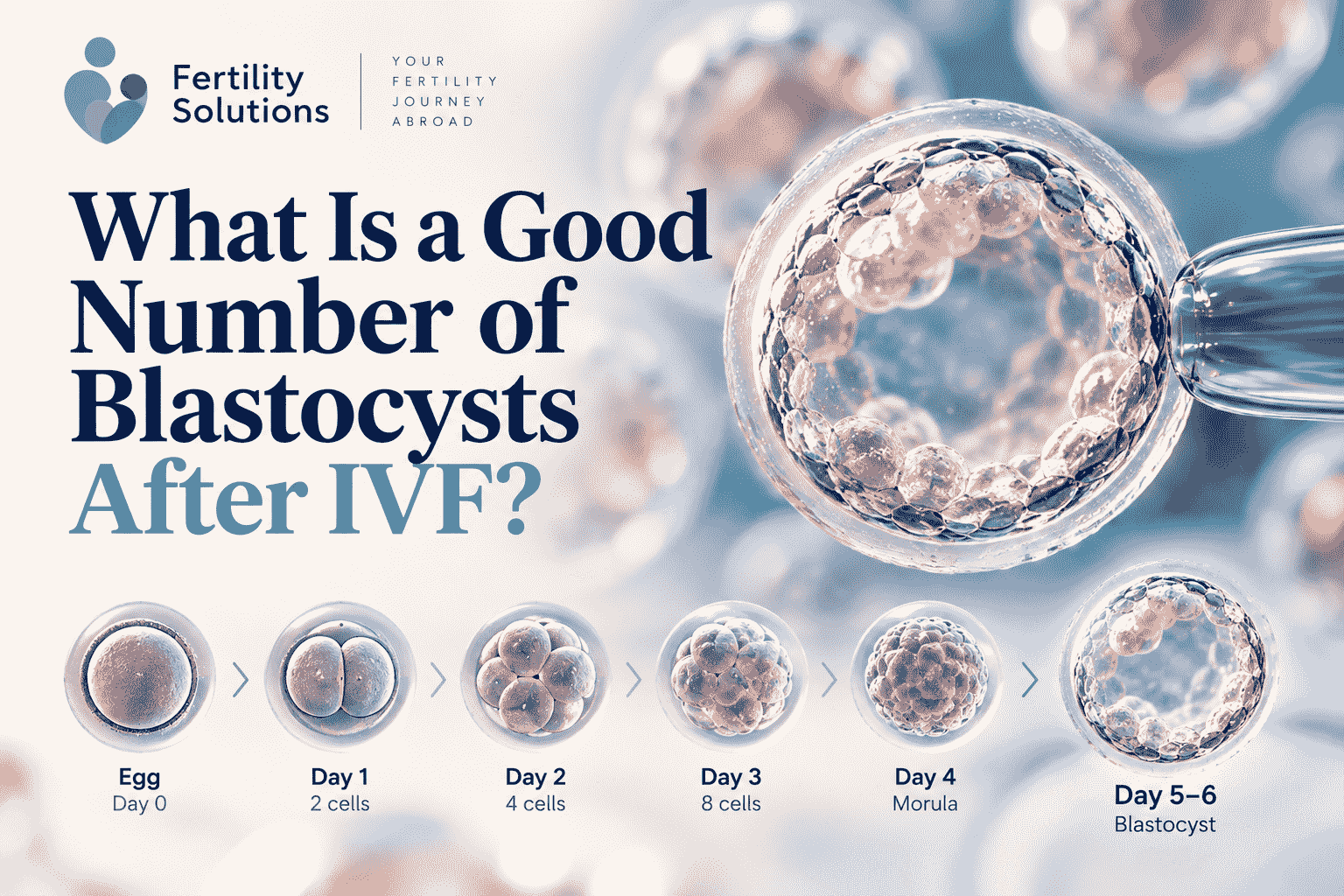
A blastocyst is an embryo that has developed for approximately five to six days after fertilization and reached an advanced stage of development.
By this point, the embryo contains many cells and begins forming two important structures:
- The inner cell mass, which develops into the fetus
- The trophectoderm, which contributes to the placenta
Reaching the blastocyst stage is an important developmental milestone.
This is also why many IVF clinics prefer blastocyst-stage embryo transfer or freezing when appropriate.
But not every fertilized egg will make it this far.
How Many Fertilized Eggs Normally Reach Day 5?
There is no exact percentage that applies to every IVF cycle.
It is normal for the number of embryos to decrease as development progresses.
Imagine, for example, that 10 eggs are retrieved.
Not all 10 may be mature.
Of the mature eggs, not all will fertilize.
And of those that fertilize, not all will continue developing into usable Day 5 or Day 6 blastocysts.
This gradual reduction is known as embryo attrition.
It does not necessarily mean something went wrong in the laboratory.
Embryos undergo extremely complex biological processes during their first several days of development. Some have the developmental potential to continue, while others naturally stop growing.
Age and egg quality can significantly influence this process.
How Many Embryos Should I Expect From 10 Eggs?
This is probably one of the most common questions patients ask after egg retrieval.
Unfortunately, there is no formula that can reliably tell us:
10 eggs = X blastocysts.
For example, two patients could both retrieve 10 eggs and finish their cycles with completely different results.
One patient might produce several blastocysts, while another might produce only one.
Why?
Because the number of eggs retrieved is only the beginning.
Those eggs must first be mature enough to fertilize. Fertilization must then occur successfully, and the embryos must continue developing for several days.
Factors affecting this process can include:
- Female age
- Egg maturity
- Egg quality
- Sperm quality
- Sperm DNA integrity
- Chromosomal abnormalities
- Fertilization
- Embryo development
- Laboratory conditions
- Individual biological variation
This is why we encourage patients not to become overly focused on the original number of eggs.
Ultimately, embryo quality and developmental potential matter more than simply having a large number of eggs retrieved.
Is One Blastocyst Enough?
Yes. One blastocyst can be enough to achieve a pregnancy.
You don’t need five or ten embryos to become pregnant.
A successful pregnancy ultimately begins with one embryo that implants and continues developing.
This is especially important for patients who feel disappointed when only one embryo reaches the blastocyst stage.
Having one blastocyst does not mean your IVF cycle has automatically failed.
However, having multiple suitable blastocysts can provide additional opportunities if the first embryo transfer is unsuccessful or if a patient hopes for more than one child.
The chance associated with an individual blastocyst depends on several factors, including:
- Maternal age
- Embryo quality
- Chromosomal status, if tested
- Uterine factors
- Endometrial preparation
- Transfer conditions
So rather than asking only “How many blastocysts do I have?”, it is useful to also ask:
“What do we know about the quality and developmental potential of the blastocysts I have?”
Why Do Embryos Stop Developing Before Blastocyst?
Embryo development is an extraordinarily complicated biological process.
An embryo may fertilize normally and begin dividing, only to stop developing on Day 3, Day 4 or before reaching the blastocyst stage.
This is known as embryo arrest.
There can be several possible reasons.
Chromosomal Abnormalities
Chromosomal abnormalities are an important cause of developmental arrest.
An embryo may begin dividing but contain genetic abnormalities that interfere with its ability to continue normal development.
The likelihood of chromosomal abnormalities generally increases with maternal age, although they can occur at any reproductive age.
Egg Quality
The egg provides much of the biological machinery required during the earliest stages of embryo development.
Poor egg quality can therefore contribute to abnormal fertilization or embryos stopping before the blastocyst stage.
Age is an important factor in egg quality, but it is not the only consideration.
Sperm Quality
The male partner also contributes half of the embryo’s genetic material.
Certain sperm problems, including significant DNA damage, may affect fertilization or subsequent embryo development.
This is why fertility assessment should not focus exclusively on the woman.
Natural Embryo Selection
Sometimes there is no obvious abnormality in the IVF process.
Not every fertilized egg has the biological potential to become a viable blastocyst.
Some degree of embryo attrition is expected even in apparently healthy patients.
Does Reaching Day 5 Mean an Embryo Is Chromosomally Normal?
No.
Reaching the blastocyst stage is encouraging, but it does not automatically mean that an embryo is chromosomally normal.
A blastocyst can appear morphologically excellent under the microscope and still have a chromosomal abnormality.
Likewise, embryo appearance alone cannot tell us everything about its genetic status.
When medically appropriate, PGT-A may be used to screen blastocysts for chromosome number abnormalities.
However, PGT-A is not required for every IVF patient and should be considered according to individual circumstances.
Is a Day 6 Blastocyst Still Good?
Yes.
Not every embryo develops at exactly the same speed.
Some reach the blastocyst stage on Day 5, while others require until Day 6.
Day 6 blastocysts can result in successful pregnancies and healthy births.
The day an embryo reaches blastocyst is one factor your embryology team considers, but it should not be interpreted in isolation.
Embryo morphology, developmental pattern, patient age and—where applicable—genetic testing results may also be relevant.
Is More Always Better?
Having several blastocysts can certainly be advantageous because it may provide more opportunities for embryo transfer.
But IVF is not simply a numbers competition.
Retrieving a large number of eggs does not guarantee a pregnancy, just as producing only one or two blastocysts does not mean treatment cannot succeed.
For example, one patient may produce eight blastocysts but discover through PGT-A that only a small number are euploid.
Another patient may produce only two blastocysts and achieve pregnancy from the first transfer.
This is why quantity and quality need to be considered together.
What If I Have No Blastocysts?
When none of the fertilized embryos reach blastocyst, your medical and embryology teams should review the cycle carefully.
They may consider:
- How many eggs were retrieved
- How many eggs were mature
- Fertilization rate
- The stage at which embryos stopped developing
- Egg morphology and maturity
- Semen analysis
- Male-factor infertility
- Previous IVF results
- Ovarian stimulation response
- Maternal age
One unsuccessful cycle does not necessarily predict exactly what will happen in another.
Your doctor may recommend modifying the stimulation protocol, investigating possible male or female factors, or discussing alternative treatment strategies depending on your individual circumstances.
Does Age Affect the Number of Blastocysts?
Age can have a significant effect on IVF outcomes because egg quality and chromosome competence change over time.
A patient may still retrieve a reasonable number of eggs at an older reproductive age, but a smaller proportion may ultimately become chromosomally normal embryos.
This is why two women who retrieve the same number of eggs can have very different IVF outcomes.
Egg number and egg quality are not the same thing.
AMH and antral follicle count can help doctors estimate ovarian reserve and expected response to stimulation, but they cannot tell us with certainty how many healthy blastocysts a patient will produce.
What Is a “Good” Number of Blastocysts?
There really isn’t one universal answer.
For one patient, five blastocysts may represent an excellent outcome.
For another patient with very low ovarian reserve, reaching the blastocyst stage with a single embryo may be a meaningful result.
Your result should be interpreted according to:
- Your age
- Ovarian reserve
- Number of eggs retrieved
- Number of mature eggs
- Fertilization results
- Previous IVF history
- Sperm factors
- Embryo development
Rather than comparing your blastocyst number with someone else’s IVF cycle, compare it with what could reasonably be expected from your individual fertility situation.
One Blastocyst Can Still Be One Opportunity
IVF involves numbers at almost every stage.
Follicles.
Eggs.
Mature eggs.
Fertilized eggs.
Day 3 embryos.
Blastocysts.
Embryo grades.
For patients, watching those numbers decrease can be emotionally difficult.
But the goal of IVF isn’t simply to finish treatment with the largest possible number of embryos.
The goal is to identify an embryo with the potential to establish a healthy ongoing pregnancy.
Sometimes there are several.
Sometimes there is only one.
And one suitable blastocyst can still represent a real opportunity for pregnancy.
If embryo development has been unexpectedly poor or repeated IVF cycles have resulted in very few or no blastocysts, the next step should be an individualized review with your fertility specialist and embryology team.
Understanding where embryo development was lost can often be more useful than simply looking at the final number.
SEO Title
What Is a Good Number of Blastocysts After IVF? Day 5 Embryos Explained
Meta Description
How many fertilized eggs normally reach Day 5? Learn how many blastocysts you might expect after IVF, whether one blastocyst can be enough, and why some embryos stop developing before blastocyst.
For any of your fertility problems, please do not hesitate to contact us. At Fertility Solutions we pride ourselves with the excellent tailored personal care we provide to our patients for their specific needs. A team member will contact you as soon as we get your message, and construct a personal treatment plan for your fertility problems in the country of Cyprus. You can also contact our clinics directly through the links below.
Get in Touch with Our Clinics:
Cyprus Crown IVF Contact: https://en.cypruscrownivf.com/contact
Cyprus American IVF Contact: https://www.cyprusamericanivf.com/contact-us/
Dr. Halil Ibrahim Tekin (Dr. HIT) Youtube: https://www.youtube.com/@dr.halilibrahimtekin1715
Cyprus American IVF Youtube: https://www.youtube.com/@AmerikanTupBebekMerkezi
Clavis Fertility Centre: https://www.clavisfertilitycenter.com