For many patients, the decision to start IVF after an abortion can come with a lot of questions and uncertainty. One of the most common concerns is how long they need to wait before beginning fertility treatment.
The answer depends on several factors, including how far along the pregnancy was, the type of abortion, whether there were any complications, and how quickly the uterus recovers afterward.
The good news is that most women can safely pursue IVF after an abortion once their body has had enough time to heal and their fertility specialist confirms that the uterus is ready for treatment.
Abortion and Future Fertility
One of the biggest misconceptions surrounding abortion is that it automatically causes infertility.
In the vast majority of cases, a medically managed or surgical abortion performed safely does not affect a woman’s future ability to become pregnant.
Most women continue to ovulate normally after an abortion and can go on to conceive naturally or through fertility treatments such as IVF.
However, every patient is different. Before starting IVF, your fertility specialist will usually evaluate the uterus, ovaries, hormone levels, and overall reproductive health to ensure the best possible chance of success.
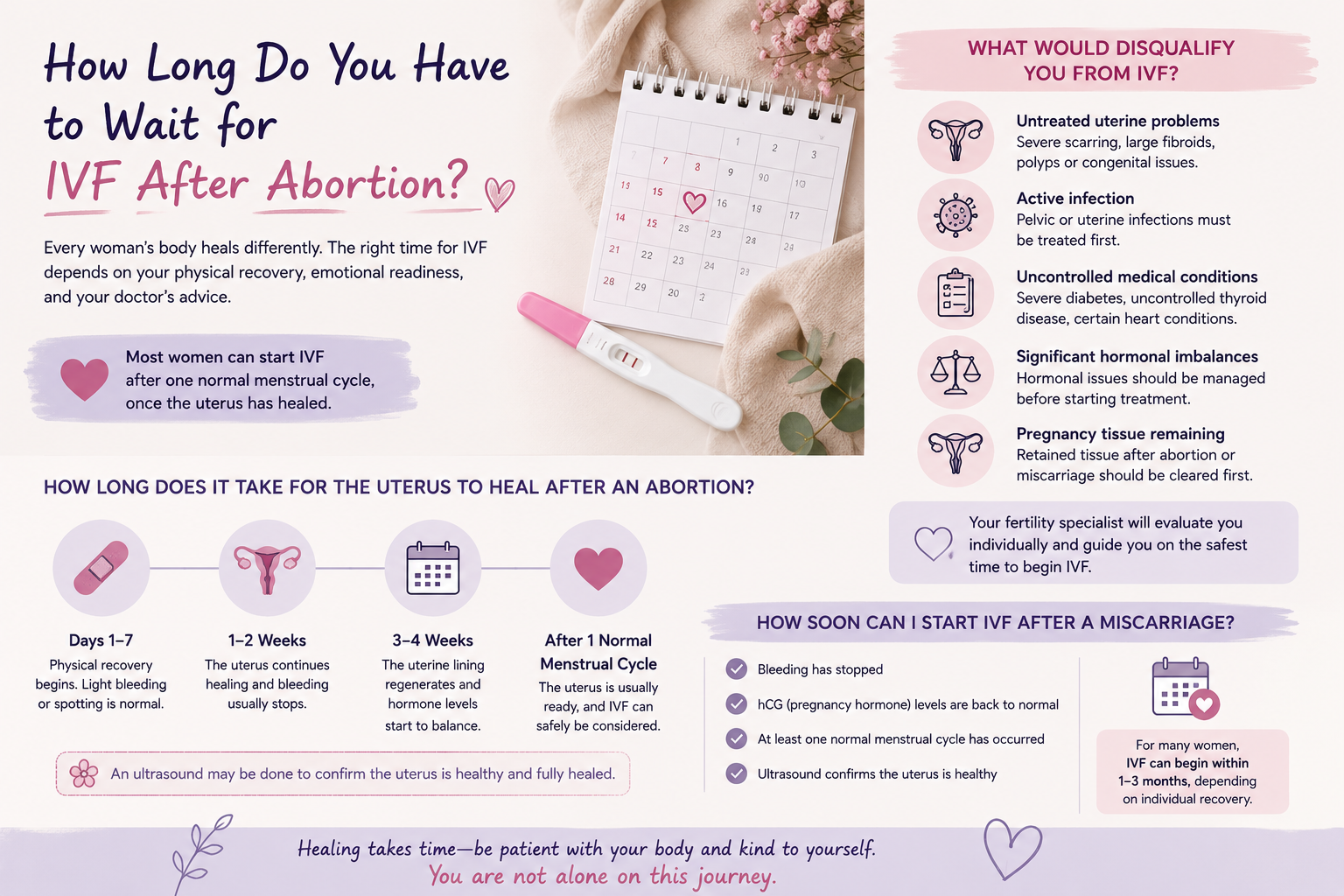
How Long Does It Take for the Uterus to Heal After an Abortion?
The uterus begins healing almost immediately after an abortion.
For most women:
- Physical recovery occurs within a few days to a few weeks.
- The uterine lining typically regenerates within one menstrual cycle.
- Hormone levels gradually return to their baseline.
In uncomplicated cases, the uterus may be ready for fertility treatment after the first normal menstrual period.
However, some patients may require additional time if they experience:
- Heavy bleeding
- Infection
- Retained pregnancy tissue
- Surgical complications
Many fertility specialists prefer to perform an ultrasound before starting IVF to confirm that the uterine cavity has returned to normal and that the lining appears healthy.
How Soon Can I Start IVF After a Miscarriage?
The timeline after a miscarriage is often similar to the timeline after an abortion.
Historically, patients were told to wait several months before trying again. Today, research suggests that many women can begin fertility treatment much sooner if they have recovered physically and emotionally.
Most fertility clinics recommend waiting until:
- Bleeding has stopped
- Pregnancy hormone (hCG) levels have returned to normal
- A normal menstrual cycle has occurred
- Ultrasound confirms the uterus is healthy
For many patients, this means IVF can begin within one to three months after a miscarriage.
The exact timing depends on individual circumstances and any investigations that may be needed to understand why the miscarriage occurred.
What Would Disqualify You From IVF?
Having had an abortion usually does not disqualify someone from IVF.
Instead, fertility specialists focus on factors that may affect treatment safety or success.
Examples include:
Untreated Uterine Problems
Conditions such as:
- Severe uterine scarring
- Large fibroids
- Untreated polyps
may need to be addressed before IVF can begin.
Active Infection
Any pelvic or uterine infection should be treated before embryo transfer to reduce risks and improve outcomes.
Uncontrolled Medical Conditions
Conditions such as:
- Severe diabetes
- Uncontrolled thyroid disease
- Certain heart conditions
may require stabilization before treatment.
Significant Hormonal Imbalances
Hormonal issues can often be treated, but they may need correction before IVF starts.
Pregnancy Tissue Remaining in the Uterus
Occasionally, retained tissue following a miscarriage or abortion can interfere with implantation and should be removed before treatment.
Why an Individual Assessment Is Important
There is no single waiting period that applies to every patient.
Some women may be ready to start IVF within weeks, while others may benefit from allowing additional time for recovery.
A fertility specialist will typically assess:
- Hormone levels
- Ovarian reserve (AMH)
- Uterine health
- Menstrual cycle recovery
- Emotional readiness
This personalized approach helps create the safest and most effective treatment plan.
Final Thoughts
For most women, having an abortion does not prevent future IVF treatment. Once the uterus has healed, hormone levels have normalized, and a fertility specialist confirms that everything looks healthy, IVF can often begin relatively quickly.
The most important step is not focusing on a fixed waiting period, but ensuring that your body is fully prepared for pregnancy.
Every fertility journey is unique, and a personalized evaluation will provide the clearest answer about when the time is right to move forward with IVF.
For any of your fertility problems, please do not hesitate to contact us. At Fertility Solutions we pride ourselves with the excellent tailored personal care we provide to our patients for their specific needs. A team member will contact you as soon as we get your message, and construct a personal treatment plan for your fertility problems in the country of Cyprus. You can also contact our clinics directly through the links below.
Get in Touch with Our Clinics:
Cyprus Crown IVF Contact: https://en.cypruscrownivf.com/contact
Cyprus American IVF Contact: https://www.cyprusamericanivf.com/contact-us/
Dr. Halil Ibrahim Tekin (Dr. HIT) Youtube: https://www.youtube.com/@dr.halilibrahimtekin1715
Cyprus American IVF Youtube: https://www.youtube.com/@AmerikanTupBebekMerkezi
Clavis Fertility Centre: https://www.clavisfertilitycenter.com