One of the most difficult decisions in fertility treatment is knowing when to move from IVF with your own eggs to egg donation.
For many patients, this is not just a medical decision — it’s deeply emotional.
The desire to have a child with your own genetic material is completely natural. But in some cases, continuing the same approach may delay the outcome you are ultimately hoping for: a healthy pregnancy.
So how do you know when it may be time to consider egg donation?
Understanding the Goal of IVF
Before discussing egg donation, it’s important to clarify something:
👉 The goal of IVF is not just to create embryos
👉 The goal is to achieve a healthy pregnancy and baby
If repeated attempts are not leading to this outcome, the strategy may need to change.
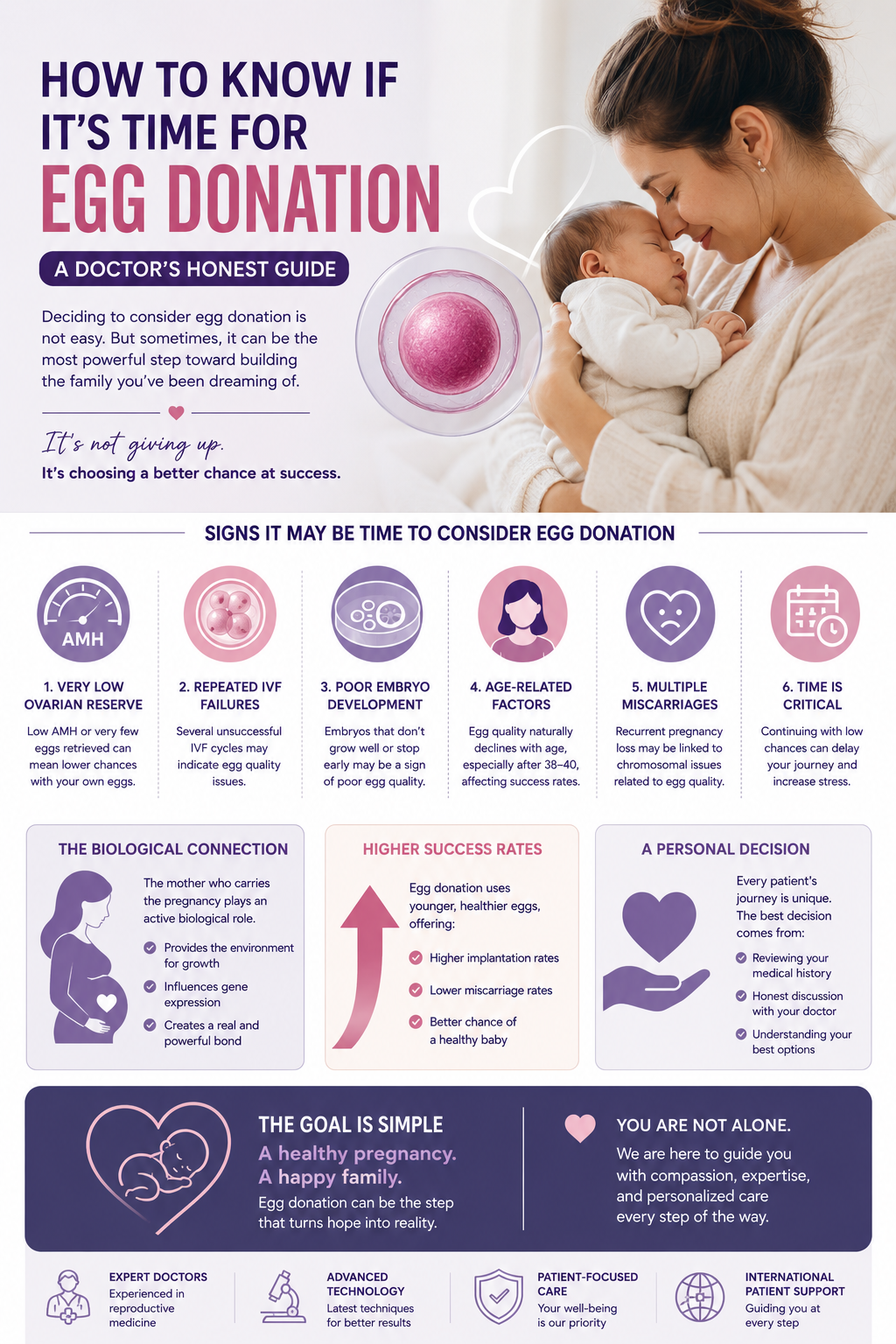
Sign 1: Very Low Ovarian Reserve
One of the most important indicators is ovarian reserve, often measured by AMH levels.
If AMH is:
- Very low (especially below 1.0)
- Or egg retrieval consistently results in very few eggs
The chances of success with own eggs become significantly reduced.
While pregnancy is still possible, it may require multiple cycles with uncertain outcomes.
Sign 2: Repeated IVF Failures
If you have undergone several IVF cycles without success, it’s important to ask:
👉 Are we repeating the same approach expecting a different result?
Repeated failure may indicate:
- Poor egg quality
- Embryos not developing properly
- Genetic abnormalities
At this stage, egg donation may offer a much higher success rate.
Sign 3: Poor Embryo Development
Sometimes eggs are retrieved, but embryos:
- Do not reach the blastocyst stage
- Stop developing early
- Are consistently low quality
This often points to underlying egg quality issues.
Sign 4: Age-Related Factors
Age plays a critical role in fertility.
As women age:
- Egg quality declines
- Chromosomal abnormalities increase
For patients over 40, IVF success with own eggs becomes more challenging.
Egg donation, using younger donor eggs, can significantly improve success rates.
Sign 5: Multiple Miscarriages
Recurrent pregnancy loss can sometimes be linked to egg quality and chromosomal abnormalities.
If miscarriages occur repeatedly despite IVF, egg donation may be considered as a more reliable option.
The Emotional Side of the Decision
Choosing egg donation is not easy.
Patients may feel:
- Loss of genetic connection
- Fear of the unknown
- Concern about bonding with the child
These feelings are completely valid.
However, many patients report that once pregnancy begins, the emotional connection becomes natural and strong.
Understanding the Biological Connection
A common misconception is that the mother carrying the pregnancy has no biological influence on the baby.
This is not entirely true.
Through epigenetics, the gestational mother:
- Provides the environment for development
- Influences gene expression
- Plays an active biological role during pregnancy
This means the connection is not only emotional — it is also biological.
Success Rates with Egg Donation
Egg donation is one of the most successful treatments in reproductive medicine.
Why?
Because it uses:
- Younger, healthy eggs
- Better genetic potential
- Higher-quality embryos
This often leads to:
- Higher implantation rates
- Lower miscarriage rates
- Increased chance of a successful pregnancy
When Continuing May Delay Success
One of the hardest realities to accept is that continuing IVF with very low chances may:
- Delay the path to pregnancy
- Increase emotional stress
- Add financial burden
In some cases, moving to egg donation earlier can shorten the journey significantly.
A Personalized Decision
There is no single “right time” for egg donation.
Every patient’s situation is unique.
The best approach is to:
- Review your full IVF history
- Understand your medical indicators
- Have an honest discussion with your doctor
A good fertility specialist will guide you — not push you.
Final Thoughts
Egg donation is not about giving up.
It is about changing direction toward a higher chance of success.
The goal is not just to try — it is to succeed.
And sometimes, the strongest decision is not continuing the same path, but choosing the one that brings you closer to your goal.
Because at the end of the journey, what matters most is not how you got there — but the family you build.
For any of your fertility problems, please do not hesitate to contact us. At Fertility Solutions we pride ourselves with the excellent tailored personal care we provide to our patients for their specific needs. A team member will contact you as soon as we get your message, and construct a personal treatment plan for your fertility problems in the country of Cyprus. You can also contact our clinics directly through the links below.
Get in Touch with Our Clinics:
Cyprus Crown IVF Contact: https://en.cypruscrownivf.com/contact
Cyprus American IVF Contact: https://www.cyprusamericanivf.com/contact-us/
Dr. Halil Ibrahim Tekin (Dr. HIT) Youtube: https://www.youtube.com/@dr.halilibrahimtekin1715
Cyprus American IVF Youtube: https://www.youtube.com/@AmerikanTupBebekMerkezi
Clavis Fertility Centre: https://www.clavisfertilitycenter.com