Many patients begin IVF hoping that their first cycle will be the one that leads to pregnancy. While this certainly happens for many couples, IVF is not always a one-cycle journey.
One of the most common questions fertility specialists hear is:
“How many IVF cycles does it usually take to get pregnant?”
The answer depends on several factors, including age, egg quality, sperm quality, embryo quality, and overall reproductive health. Understanding what is realistic can help patients approach treatment with confidence and realistic expectations.
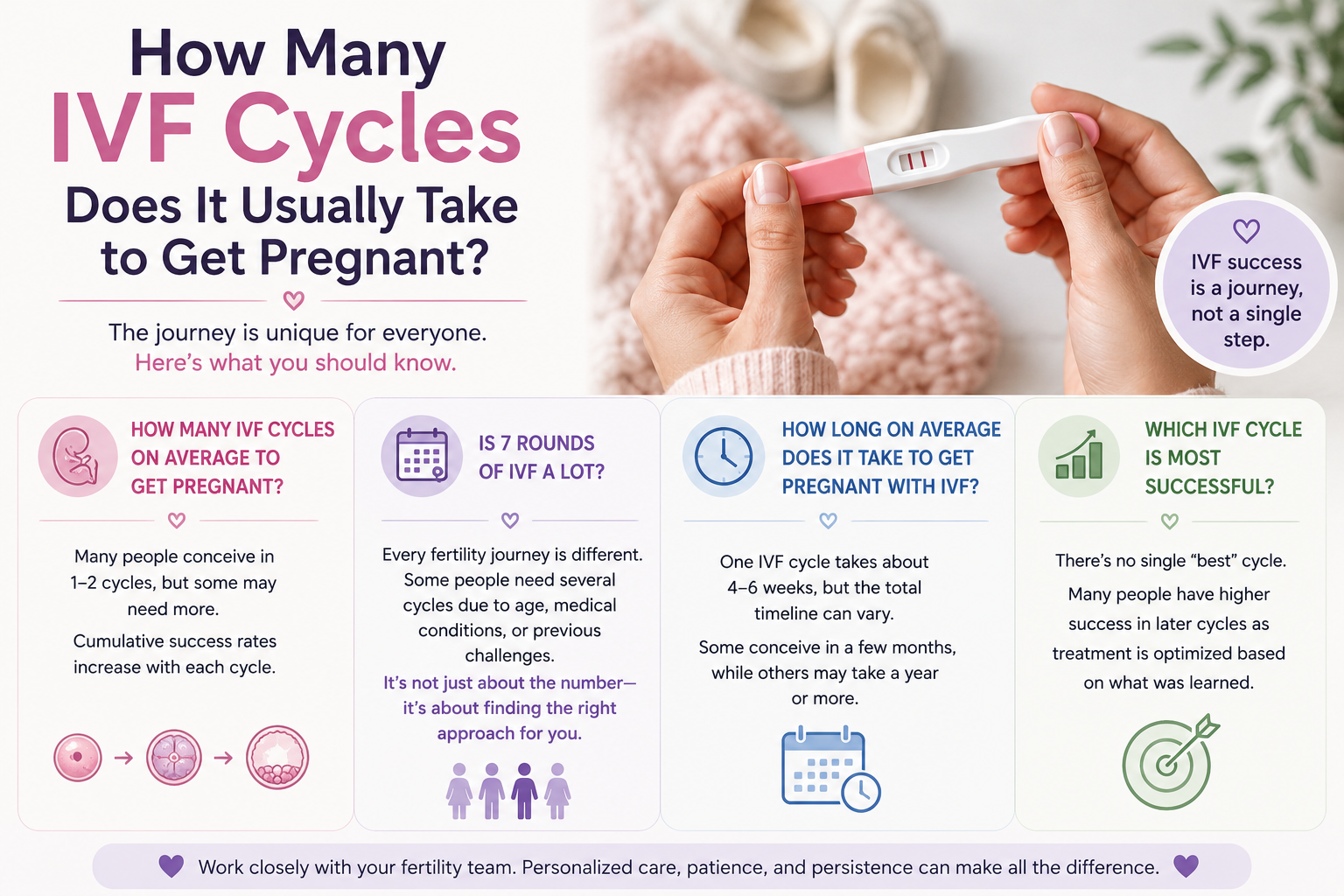
How Many IVF Cycles on Average to Get Pregnant?
There is no universal number that applies to every patient, but research consistently shows that cumulative success rates improve with multiple IVF cycles.
Many patients who do not achieve pregnancy during their first cycle may succeed during subsequent attempts.
In general:
- Some patients conceive during their first cycle.
- Others require two or three cycles.
- A smaller percentage may need additional attempts or alternative treatment strategies.
This does not mean IVF has failed. Each cycle provides valuable information that can help doctors adjust protocols and improve future treatment plans.
For many fertility specialists, success is viewed over multiple cycles rather than a single attempt.
How Long on Average Does It Take to Get Pregnant With IVF?
A single IVF cycle typically takes several weeks from the start of medications to embryo transfer.
However, the overall timeline can vary significantly depending on:
- Fertility testing requirements
- Medication preparation
- Genetic testing (PGT)
- Frozen embryo transfers
- Individual treatment plans
Some patients become pregnant within a few months of their initial consultation.
Others may require additional cycles, embryo freezing, or further investigations, extending the timeline over a year or longer.
The important thing to remember is that IVF is often a process rather than a single event.
Which IVF Cycle Is Most Successful?
Many patients assume that success rates decrease with each attempt.
Surprisingly, that is not always true.
The first cycle often serves as a learning opportunity for both the patient and the fertility team.
Doctors gain valuable information about:
- Ovarian response
- Egg quality
- Fertilization rates
- Embryo development
- Uterine receptivity
As treatment progresses, adjustments can be made to improve outcomes.
For some patients, the second or third cycle may actually be more successful because the treatment plan has become more personalized.
The “best” cycle is not necessarily the first one. It is often the cycle where the treatment strategy is most optimized for the individual patient.
Is 7 Rounds of IVF a Lot?
Hearing that someone has undergone seven IVF cycles can sound overwhelming.
The reality is that every fertility journey is unique.
Some patients achieve pregnancy quickly, while others face more complex challenges such as:
- Severe endometriosis
- Low ovarian reserve
- Recurrent implantation failure
- Recurrent miscarriage
- Male factor infertility
Seven cycles is certainly more than average, but it is not unheard of.
For some patients, repeated treatment may eventually lead to success. For others, multiple unsuccessful cycles may prompt discussions about alternative approaches such as:
- Egg donation
- Sperm donation
- Embryo donation
- Additional genetic testing
- Advanced laboratory techniques
The number itself is less important than understanding why previous cycles were unsuccessful and what changes can be made moving forward.
What Factors Influence IVF Success?
Several important factors can affect how many IVF cycles may be required.
Female Age
Age remains one of the strongest predictors of IVF success.
As age increases:
- Egg quality declines
- Chromosomal abnormalities become more common
- Pregnancy rates generally decrease
Embryo Quality
Healthy embryos are more likely to implant and develop into successful pregnancies.
Sperm Quality
Male fertility plays a significant role in embryo development and pregnancy outcomes.
Uterine Health
Successful implantation depends on a healthy uterine environment.
Laboratory Quality
Modern embryology laboratories, advanced culture systems, and experienced embryologists can make a significant difference.
The Importance of Staying Flexible
One of the biggest challenges during IVF is balancing optimism with realism.
Patients often enter treatment with a specific timeline in mind. However, fertility treatment sometimes requires adjustments along the way.
The most successful patients are often those who remain open to:
- Personalized treatment changes
- Additional testing when needed
- Alternative approaches if necessary
Each cycle provides new information that can guide the next step.
Final Thoughts
So, how many IVF cycles does it usually take to get pregnant?
For some patients, one IVF cycle might be enough. For others, it may take multiple IVF cycles before success is achieved.
The important thing to understand is that IVF success is often cumulative. Every cycle provides valuable information that can help refine treatment and improve future outcomes.
Rather than focusing solely on the number of cycles, patients should focus on working closely with their fertility team to create the most effective strategy for their individual situation.
Because in fertility treatment, persistence, personalized care, and the right medical guidance can make all the difference.
For any of your fertility problems, please do not hesitate to contact us. At Fertility Solutions we pride ourselves with the excellent tailored personal care we provide to our patients for their specific needs. A team member will contact you as soon as we get your message, and construct a personal treatment plan for your fertility problems in the country of Cyprus. You can also contact our clinics directly through the links below.
Get in Touch with Our Clinics:
Cyprus Crown IVF Contact: https://en.cypruscrownivf.com/contact
Cyprus American IVF Contact: https://www.cyprusamericanivf.com/contact-us/
Dr. Halil Ibrahim Tekin (Dr. HIT) Youtube: https://www.youtube.com/@dr.halilibrahimtekin1715
Cyprus American IVF Youtube: https://www.youtube.com/@AmerikanTupBebekMerkezi
Clavis Fertility Centre: https://www.clavisfertilitycenter.com