One of the most common questions patients ask before starting IVF is:
“How many eggs do I need for a successful IVF cycle?”
It’s a great question—but the answer is not as simple as a single number.
Many people assume that the more eggs retrieved, the higher the chance of success. While there is some truth to this, IVF success depends on much more than just quantity.
Understanding the balance between egg number and egg quality is key.
Why Egg Number Matters
During IVF, the goal of ovarian stimulation is to produce multiple eggs instead of the single egg released in a natural cycle.
Why?
Because not every egg will lead to a pregnancy.
From the total number of eggs retrieved:
- Not all eggs are mature
- Not all mature eggs fertilize
- Not all fertilized eggs become embryos
- Not all embryos reach the blastocyst stage
- Not all embryos are genetically normal
This natural drop-off means that starting with more eggs increases the chances of ending up with at least one strong embryo for transfer.
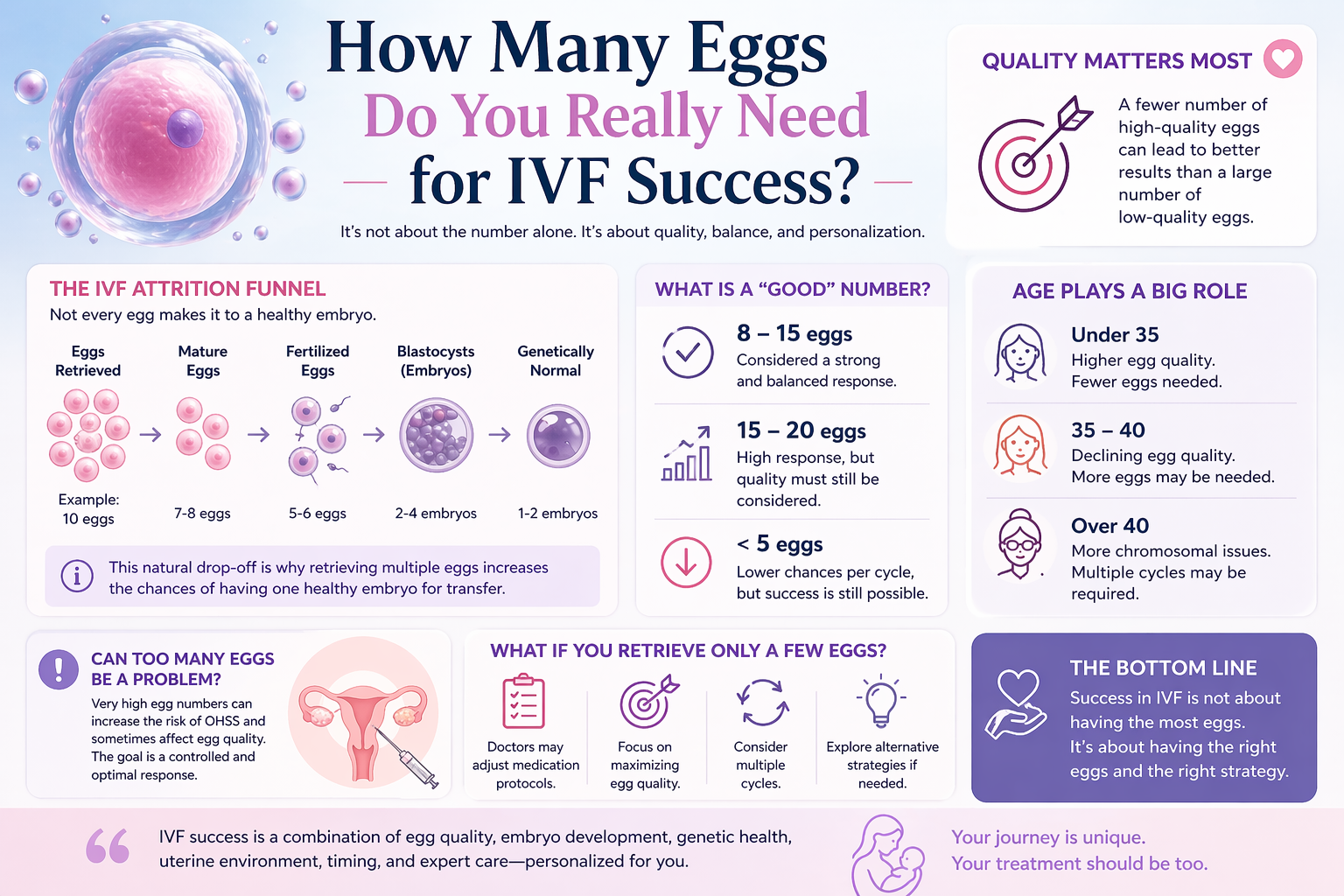
The Typical IVF “Attrition Funnel”
To understand this better, here is a simplified example:
Out of 10 eggs retrieved:
- 7–8 may be mature
- 5–6 may fertilize
- 2–4 may develop into blastocysts
- 1–2 may be genetically normal
This is why doctors aim to retrieve multiple eggs—because each stage reduces the number.
So, What Is a “Good” Number of Eggs?
There is no perfect number, but general expectations are:
- 8–15 eggs → considered a strong and balanced response
- 15–20 eggs → high response, but quality must still be considered
- Less than 5 eggs → lower chances per cycle, but still possible
It’s important to understand that more eggs does not always mean better outcomes.
Quality vs Quantity: What Matters More?
While egg number is important, egg quality is the most critical factor.
A smaller number of high-quality eggs may lead to better outcomes than a larger number of poor-quality eggs.
Egg quality is influenced mainly by:
- Age
- Genetics
- Hormonal environment
This is why younger patients may achieve success with fewer eggs, while older patients may require more cycles to achieve the same result.
Age and Egg Expectations
Age plays a major role in determining how many eggs are needed.
Under 35
- Higher egg quality
- Fewer eggs needed for success
35–40
- Declining egg quality
- More eggs may be needed to find a healthy embryo
Over 40
- Increased chromosomal abnormalities
- Multiple cycles may be needed
This is why IVF treatment is often personalized based on age.
Can Too Many Eggs Be a Problem?
Interestingly, retrieving too many eggs can also have downsides.
Very high egg numbers may increase the risk of ovarian hyperstimulation syndrome (OHSS) and sometimes affect egg quality.
The goal is not “as many eggs as possible,” but rather a controlled and optimal response.
What If You Retrieve Only a Few Eggs?
Many patients worry when they produce only a small number of eggs.
While it can reduce the chances per cycle, it does not mean IVF will fail.
In these cases, doctors may:
- Adjust medication protocols
- Focus on maximizing egg quality
- Consider multiple cycles
- Explore alternative strategies if needed
Even a single good-quality egg can result in pregnancy.
The Role of Personalized Treatment
Modern IVF is not about chasing a number—it’s about tailoring treatment to the individual.
Doctors consider:
- Ovarian reserve (AMH levels)
- Age
- Previous cycle response
- Overall health
The goal is to create the best possible outcome for each patient, not to meet a fixed egg target.
Final Thoughts
So, how many eggs do you really need for IVF success?
The honest answer is:
👉 Enough to give you a strong chance—but not more than your body can safely handle.
IVF success is not determined by egg number alone. It’s a combination of:
- Egg quality
- Embryo development
- Genetic health
- Uterine environment
- Timing and medical strategy
Rather than focusing only on the number, patients should focus on overall treatment quality and personalized care.
Because in IVF, success is not about having the most eggs—it’s about having the right ones.
For any of your fertility problems, please do not hesitate to contact us. At Fertility Solutions we pride ourselves with the excellent tailored personal care we provide to our patients for their specific needs. A team member will contact you as soon as we get your message, and construct a personal treatment plan for your fertility problems in the country of Cyprus. You can also contact our clinics directly through the links below.
Get in Touch with Our Clinics:
Cyprus Crown IVF Contact: https://en.cypruscrownivf.com/contact
Cyprus American IVF Contact: https://www.cyprusamericanivf.com/contact-us/
Dr. Halil Ibrahim Tekin (Dr. HIT) Youtube: https://www.youtube.com/@dr.halilibrahimtekin1715
Cyprus American IVF Youtube: https://www.youtube.com/@AmerikanTupBebekMerkezi
Clavis Fertility Centre: https://www.clavisfertilitycenter.com