Embryo arrest during IVF treatment can cause a lot of confusion, and panic amongst patients. One of the hardest updates to receive during IVF is hearing that an embryo has stopped developing.
Egg retrieval may have gone well. Fertilization may have occurred normally. Then, over the following days, the embryology laboratory reports that one or more embryos are no longer progressing.
Naturally, patients want to know why.
Embryo development is an incredibly complex biological process. Not every fertilized egg will become a blastocyst, and an embryo stopping during development does not necessarily mean something went wrong in the laboratory.
Egg quality, sperm quality, chromosomal abnormalities and the embryo’s own developmental potential can all play a role.
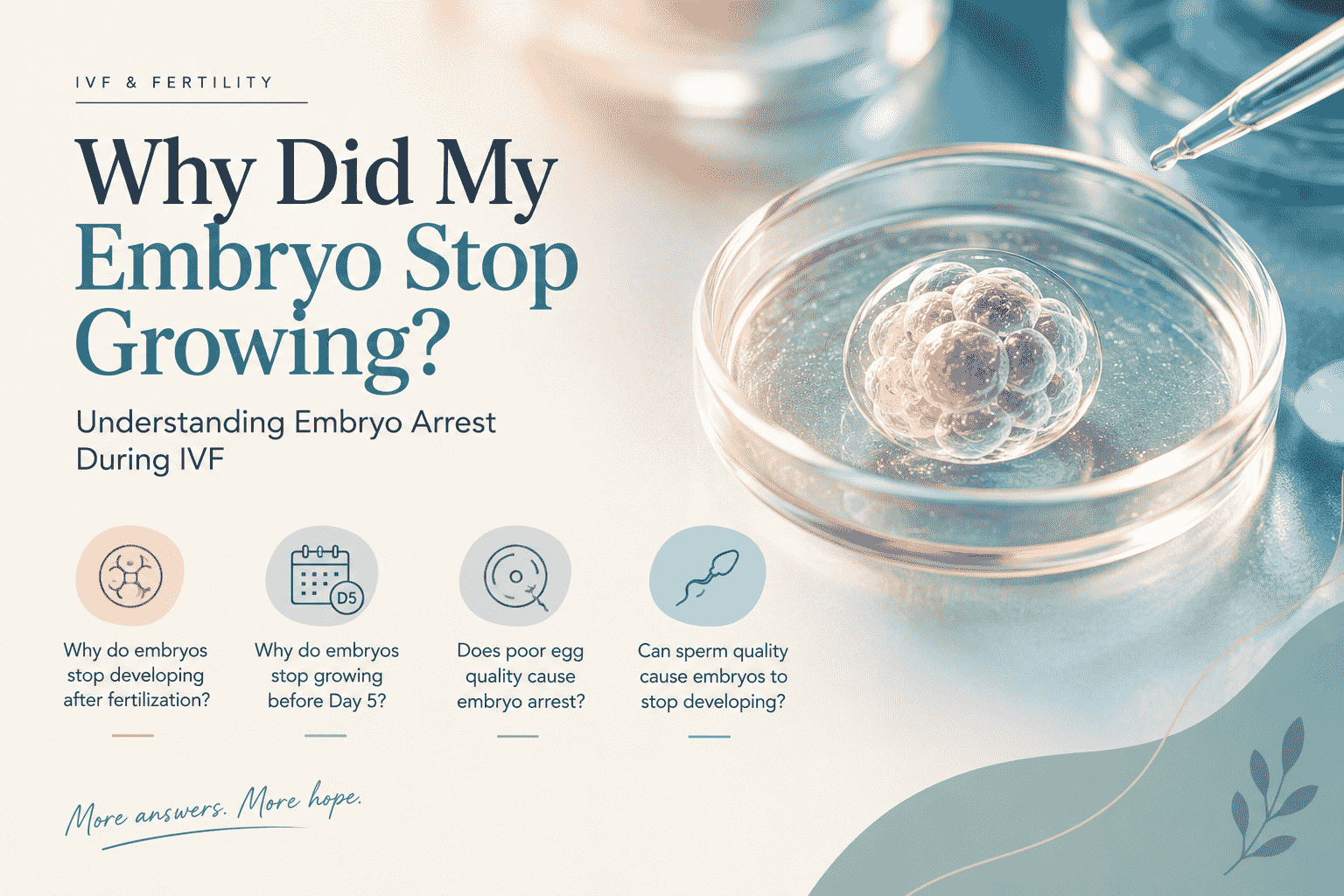
Why Do Embryos Stop Developing After Fertilization?
Fertilization is only the beginning.
Once an egg has been fertilized, the resulting embryo must repeatedly divide its cells while activating and regulating thousands of biological processes.
Some embryos simply do not have the biological potential to continue developing.
One important reason is chromosomal abnormality. An embryo may contain too many or too few chromosomes, which can interfere with normal development.
Other possible factors include:
- Egg quality
- Sperm quality
- DNA damage
- Problems during cell division
- Maternal age
- Laboratory and culture conditions
In many cases, there isn’t one simple explanation.
An embryo can look promising during its first few days and still stop developing later.
Why Do Embryos Stop Growing Before Day 5?
During IVF, embryos are commonly cultured in the laboratory until approximately Day 5 or Day 6, when successfully developing embryos may reach the blastocyst stage.
But not every fertilized egg will make it that far.
An embryo that looks good on Day 3 may slow down or stop before reaching blastocyst.
This period involves major developmental changes. The embryo must continue dividing, organize its cells and activate its own genome.
Embryologists monitor this progression closely, but they cannot force an embryo to continue developing.
This is also why the number of embryos usually decreases at each stage of IVF.
For example, the number of eggs retrieved is not expected to equal the number of blastocysts ultimately available for transfer or freezing.
Some natural attrition during embryo development is expected.
Does Poor Egg Quality Cause Embryo Arrest?
Yes, egg quality can be an important factor.
The egg contributes much of the cellular machinery needed during the earliest stages of embryo development.
As women get older, the likelihood of chromosomal abnormalities in their eggs generally increases. This is one of the main reasons IVF success rates tend to decline with maternal age.
Poor egg quality may contribute to:
- Failed fertilization
- Abnormal cell division
- Slow embryo development
- Embryo arrest
- Failure to reach blastocyst
- Chromosomally abnormal embryos
However, low ovarian reserve and poor egg quality are not exactly the same thing.
A woman with low AMH may produce fewer eggs, but those eggs are not automatically poor quality. Age remains one of the strongest indicators of the likelihood of chromosomal abnormalities.
Can Sperm Quality Cause Embryos to Stop Developing?
Yes.
IVF is not only about the egg.
The sperm contributes half of the embryo’s genetic material, and significant problems with sperm quality can potentially affect fertilization and subsequent embryo development.
One area fertility specialists may investigate is sperm DNA fragmentation.
A standard semen analysis looks at factors such as:
- Sperm concentration
- Movement (motility)
- Morphology
- Semen volume
But sperm that appears relatively normal on a standard semen analysis may still have increased DNA fragmentation.
Higher sperm DNA fragmentation has been associated with poorer reproductive outcomes in some circumstances, although its exact clinical importance varies between patients.
If repeated IVF cycles show unexpectedly poor embryo development, your fertility specialist may therefore consider both female and male factors rather than assuming the eggs are responsible.
If My Embryos Stop Growing, Does It Mean IVF Won’t Work?
No.
One unsuccessful cycle does not necessarily predict what will happen during the next one.
IVF also provides doctors and embryologists with valuable information about how your eggs, sperm and embryos behave in the laboratory.
After significant embryo arrest, your fertility team may review:
- Ovarian stimulation response
- Number of mature eggs
- Fertilization rate
- Sperm parameters
- Embryo development from Day 1 onward
- Maternal and paternal age
- Previous IVF history
Depending on the findings, the treatment strategy may be adjusted before another attempt.
What Can Be Done After Embryo Arrest?
There is no single treatment for embryo arrest because the underlying reason can differ from patient to patient.
Your fertility specialist may recommend further evaluation of egg and sperm factors, modifications to the IVF protocol or additional testing where clinically appropriate.
For patients with repeated poor embryo development related to significant concerns about egg quality, options such as egg donation or a tandem cycle may eventually be discussed.
A tandem cycle allows a patient’s own eggs and donor eggs to be used within the treatment strategy, providing another option for patients who still want an opportunity to attempt IVF with their own eggs while also having donor eggs available.
This isn’t necessary for everyone, and the decision should be based on the patient’s age, ovarian reserve, previous IVF results and individual circumstances.
Does One Arrested Embryo Mean All My Embryos Are Abnormal?
No.
Embryos from the same IVF cycle can behave very differently.
One embryo may stop developing on Day 3 while another reaches a high-quality blastocyst on Day 5 or Day 6.
This is why embryologists monitor each embryo individually.
Ultimately, IVF isn’t about getting every fertilized egg to become a blastocyst. The goal is to identify the embryo or embryos with the strongest potential for a healthy pregnancy.
Final Thoughts
Watching embryo numbers decrease between fertilization and Day 5 can be one of the most stressful parts of IVF.
But some degree of embryo attrition is a normal part of human reproduction.
When embryos repeatedly stop developing, the important question isn’t simply “Why did my IVF fail?”
It’s:
“What did this cycle teach us?”
Egg quality, sperm quality, chromosomal abnormalities and embryo biology can all contribute to developmental arrest.
By carefully reviewing what happened at each stage, an experienced fertility team can determine whether additional testing, a different IVF protocol or another treatment approach should be considered.
Sometimes the information gained from one difficult cycle becomes exactly what is needed to plan the next one.
For any of your fertility problems, please do not hesitate to contact us. At Fertility Solutions we pride ourselves with the excellent tailored personal care we provide to our patients for their specific needs. A team member will contact you as soon as we get your message, and construct a personal treatment plan for your fertility problems in the country of Cyprus. You can also contact our clinics directly through the links below.
Get in Touch with Our Clinics:
Cyprus Crown IVF Contact: https://en.cypruscrownivf.com/contact
Cyprus American IVF Contact: https://www.cyprusamericanivf.com/contact-us/
Dr. Halil Ibrahim Tekin (Dr. HIT) Youtube: https://www.youtube.com/@dr.halilibrahimtekin1715
Cyprus American IVF Youtube: https://www.youtube.com/@AmerikanTupBebekMerkezi
Clavis Fertility Centre: https://www.clavisfertilitycenter.com