Receiving your PGT-A results can sometimes create more questions than answers.
You may expect embryos to be classified simply as “normal” or “abnormal,” only to discover that one of your embryos has been reported as mosaic.
So, what exactly does that mean?
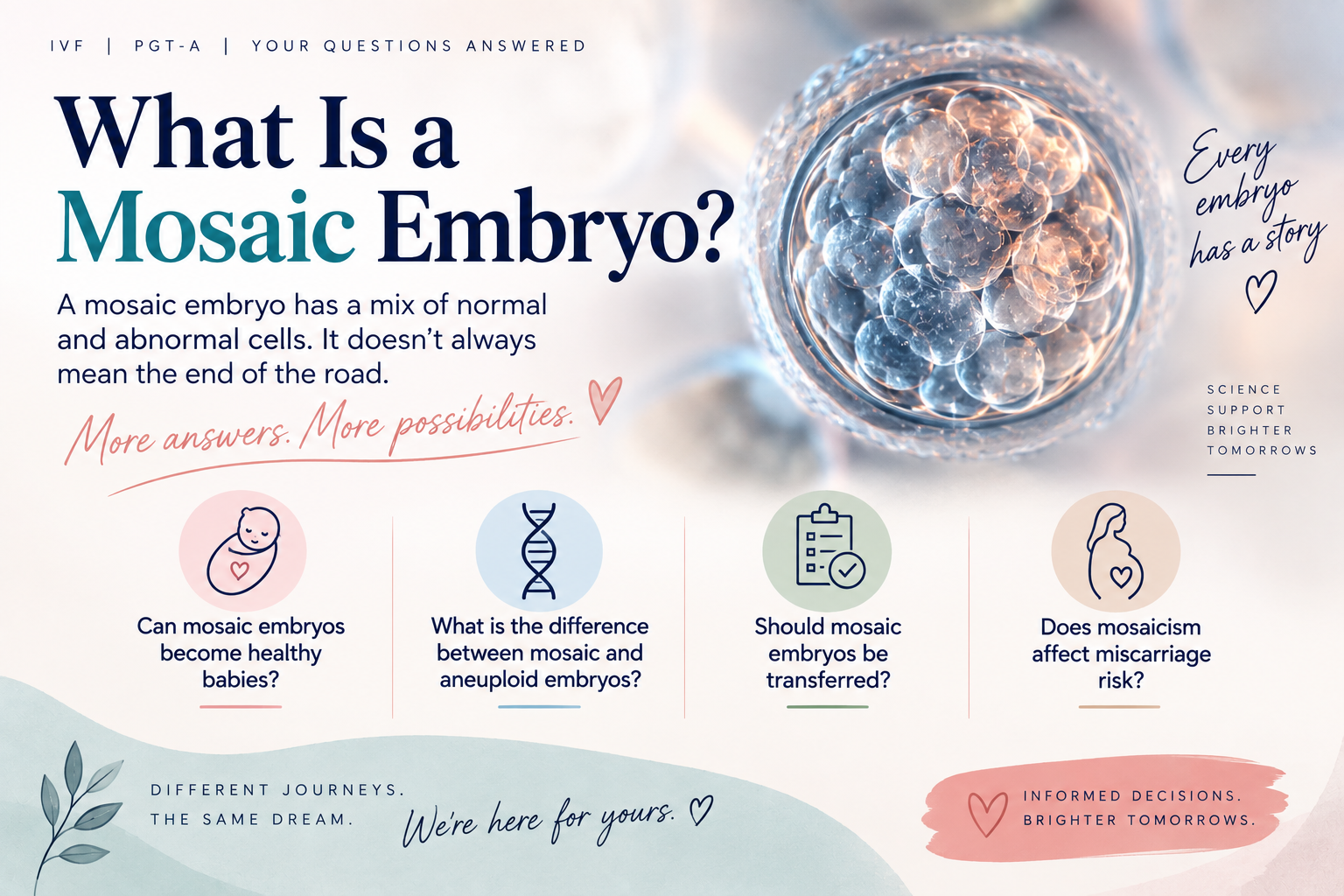
A mosaic result generally means that the cells sampled during PGT-A showed a mixture of apparently chromosomally normal and abnormal cells.
Importantly, a mosaic embryo isn’t necessarily the same as an aneuploid embryo. Some mosaic embryos have resulted in healthy pregnancies and healthy babies, which is why their potential use has become an important—and sometimes complicated—conversation in modern IVF.
Let’s break down what patients should know.
What Is a Mosaic Embryo?
Normally, human cells contain 46 chromosomes arranged in 23 pairs.
During embryo development, cells divide rapidly. Sometimes an error occurs during this process and different cells can end up with different chromosome findings.
When PGT-A analyzes a small sample of cells from a blastocyst, the laboratory may detect a mixture of apparently normal and abnormal chromosome signals.
This may be reported as mosaicism.
A PGT-A result is based on cells biopsied from the trophectoderm, which develops primarily into the placenta. It does not test every cell of the embryo.
This is one reason mosaic PGT-A results require careful interpretation.
Can Mosaic Embryos Become Healthy Babies?
Yes, they can.
Healthy pregnancies and births have been reported following the transfer of embryos classified as mosaic by PGT-A.
However, that does not mean every mosaic embryo has the same reproductive potential.
The outcome may depend on factors such as:
- Which chromosome is involved
- Whether the finding involves a whole chromosome or part of one
- The reported level of mosaicism
- Embryo quality
- The specific PGT-A laboratory and testing platform
In general, mosaic embryos may have lower implantation rates and higher miscarriage rates than euploid embryos, although outcomes vary considerably depending on the particular finding.
This is why mosaic embryo transfer should be considered individually rather than treating every mosaic embryo as belonging to one category.
What Is the Difference Between Mosaic and Aneuploid Embryos?
Understanding the terminology makes PGT-A reports much easier to interpret.
Euploid Embryo
A euploid result means the tested sample showed the expected chromosome number.
When available, euploid embryos are generally prioritized for transfer.
Mosaic Embryo
A mosaic result indicates a mixture of normal and abnormal chromosome signals within the biopsy sample.
Some mosaic embryos may retain reproductive potential.
Aneuploid Embryo
An aneuploid result indicates that the tested cells showed an abnormal number of chromosomes, such as an extra or missing chromosome.
These embryos generally have a much lower chance of producing a healthy ongoing pregnancy, although PGT-A remains a screening test rather than a diagnosis of every cell in an embryo.
So, in simplified terms:
Euploid → expected chromosome result
Mosaic → mixture of signals
Aneuploid → abnormal chromosome result
The reality is more complicated than these three labels, which is why PGT-A reports should be interpreted with your fertility specialist and, where appropriate, a genetic counselor.
Should Mosaic Embryos Be Transferred?
Sometimes—but not automatically.
If a patient has both euploid and mosaic embryos available, a euploid embryo would generally be prioritized.
The question becomes more difficult when no euploid embryos remain.
For example, imagine a patient completes IVF and receives the following PGT-A results:
- No euploid embryos
- One or more aneuploid embryos
- One mosaic embryo
In this situation, the mosaic embryo may deserve further evaluation rather than being automatically discarded.
Your fertility specialist and genetic counselor can review the specific result and discuss the potential benefits, limitations and risks of transfer.
Factors considered may include:
- Type of mosaicism
- Chromosome involved
- Level of mosaicism reported
- Patient age
- Previous IVF history
- Availability of other embryos
- Possibility of another egg retrieval
The decision should always be personalized.
Does Mosaicism Affect Miscarriage Risk?
It can.
Compared with euploid embryo transfers, mosaic embryo transfers as a group have been associated with a higher risk of implantation failure and miscarriage.
But the risk is not identical for every mosaic embryo.
Some mosaic embryos implant and develop normally, while others fail to implant or miscarry.
This is another reason why the exact PGT-A finding matters.
A laboratory report that simply says “mosaic” doesn’t tell the entire story.
Patients should discuss the specific chromosome finding and reported mosaic level with professionals experienced in interpreting PGT-A results.
If a Mosaic Embryo Implants, Will the Baby Have a Chromosomal Condition?
Not necessarily.
Healthy babies have been born following mosaic embryo transfers.
However, because PGT-A is a screening test and a mosaic result creates additional uncertainty, genetic counseling is especially important.
If pregnancy occurs following mosaic embryo transfer, your healthcare team may discuss prenatal diagnostic testing such as chorionic villus sampling (CVS) or amniocentesis, depending on the particular circumstances.
Standard prenatal screening tests and diagnostic tests are not the same, so your obstetric and genetics teams can explain which approach is appropriate.
Why Can PGT-A Detect Mosaicism?
PGT-A examines a small number of cells removed from the outer portion of a blastocyst.
Modern genetic testing is sensitive enough to detect chromosome signals that appear to contain a mixture of normal and abnormal cells.
However, interpreting those signals is complicated.
The biopsy represents only a small sample of the embryo, and laboratories can use different thresholds and reporting practices when classifying mosaic results.
Therefore, PGT-A shouldn’t be thought of as a perfect photograph of every cell inside an embryo.
It is a sophisticated screening tool that provides information doctors can use alongside the patient’s broader clinical picture.
Can a Mosaic Embryo Be Your Only Embryo?
Yes.
This can be one of the most difficult situations for IVF patients.
After stimulation, egg retrieval, fertilization, blastocyst development and PGT-A, a mosaic embryo may sometimes be the only embryo remaining with potential for consideration.
At this point, there isn’t one answer that is right for everyone.
Some patients may decide to attempt another egg retrieval in the hope of creating a euploid embryo.
Others—particularly when another retrieval is unlikely or difficult—may want to discuss whether their mosaic embryo could reasonably be considered for transfer.
Neither decision should be made from the word “mosaic” alone.
The complete genetic report matters.
Should I Do Another Egg Retrieval Instead?
That depends on your circumstances.
Another retrieval may be considered when:
- The patient is younger
- Ovarian reserve remains reasonable
- Another cycle is medically appropriate
- There is a realistic opportunity to create additional embryos
For patients with advanced maternal age, very low ovarian reserve or several unsuccessful cycles, the discussion may be different.
Options might eventually include another retrieval, transfer of an appropriately evaluated mosaic embryo, a tandem cycle or egg donation.
The goal isn’t to follow the same rule for every patient.
It’s to understand the realistic options and choose the approach that makes sense for that individual.
Final Thoughts
A mosaic PGT-A result can initially sound frightening, but mosaic does not automatically mean an embryo has no potential.
Healthy pregnancies and births have occurred after mosaic embryo transfer.
At the same time, mosaic embryos shouldn’t be treated exactly like euploid embryos. Implantation rates may be lower, miscarriage risk may be higher, and the specific chromosome finding can significantly influence the conversation.
If you receive a mosaic result, don’t make a decision based solely on a label.
Ask your fertility specialist:
Which chromosome is involved? How was the mosaicism classified? What does the laboratory report actually show? And what alternatives do I have?
When mosaic embryo transfer is being considered, genetic counseling can be an especially valuable part of that decision.
PGT-A gives us important information—but understanding what that information means for your particular embryo and your particular fertility journey is what matters most.
For any of your fertility problems, please do not hesitate to contact us. At Fertility Solutions we pride ourselves with the excellent tailored personal care we provide to our patients for their specific needs. A team member will contact you as soon as we get your message, and construct a personal treatment plan for your fertility problems in the country of Cyprus. You can also contact our clinics directly through the links below.
Get in Touch with Our Clinics:
Cyprus Crown IVF Contact: https://en.cypruscrownivf.com/contact
Cyprus American IVF Contact: https://www.cyprusamericanivf.com/contact-us/
Dr. Halil Ibrahim Tekin (Dr. HIT) Youtube: https://www.youtube.com/@dr.halilibrahimtekin1715
Cyprus American IVF Youtube: https://www.youtube.com/@AmerikanTupBebekMerkezi
Clavis Fertility Centre: https://www.clavisfertilitycenter.com