Seeing a positive pregnancy test after IVF can feel like the moment you’ve been waiting for. After medications, egg retrieval, embryo development and finally embryo transfer, a positive beta-hCG result can bring enormous relief.
That’s why being told a few days later that the pregnancy is no longer progressing can be particularly difficult.
This is known as a chemical pregnancy.
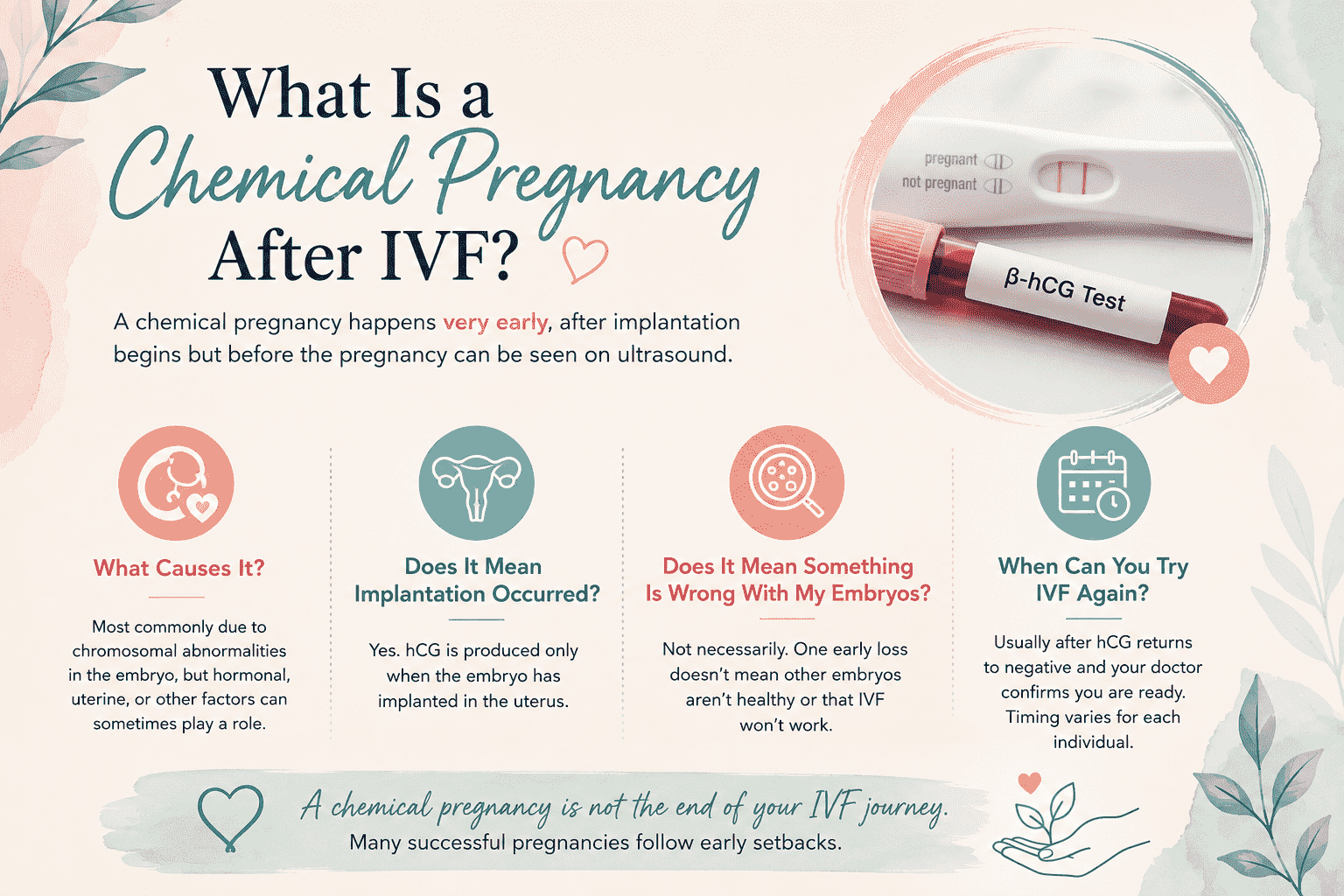
A chemical pregnancy is a very early pregnancy loss that happens before the pregnancy can usually be confirmed on ultrasound. Importantly, it means that implantation did begin—the embryo produced enough hCG for a pregnancy test to become positive—but development stopped very early.
So why does this happen, and what does it mean for your next IVF attempt?
What Is a Chemical Pregnancy After IVF?
A chemical pregnancy occurs when an embryo implants sufficiently for the body to begin producing human chorionic gonadotropin (hCG), but the pregnancy stops developing at a very early stage.
After IVF, clinics usually perform a blood test—known as a beta-hCG test—following embryo transfer.
If hCG is detected, the test is considered positive.
Your fertility clinic may then repeat the blood test to see whether the hCG level is rising appropriately.
With a chemical pregnancy, hCG may initially rise but then:
- Increase more slowly than expected
- Plateau
- Begin to fall
Because the pregnancy ends so early, an ultrasound usually does not yet show a gestational sac.
What Causes a Chemical Pregnancy?
There isn’t always a clear answer.
One of the most common reasons for very early pregnancy loss is believed to be chromosomal abnormalities in the embryo.
An embryo may fertilize normally, develop into a blastocyst, look good under the microscope and even begin implantation while still having a chromosomal problem that prevents continued development.
Other factors may sometimes contribute, including:
- Embryo-related factors
- Maternal age
- Uterine abnormalities
- Hormonal factors
- Certain underlying medical conditions
However, experiencing one chemical pregnancy does not automatically mean there is an underlying fertility problem beyond the reason IVF was needed in the first place.
Very early pregnancy loss can also occur during natural conception.
Does a Chemical Pregnancy Mean the Embryo Implanted?
Yes.
This is an important point.
For hCG to become detectable following embryo transfer, implantation must have started.
The embryo reached the uterus, interacted with the endometrium and began the implantation process.
Unfortunately, development then stopped before the pregnancy progressed far enough to be seen on ultrasound.
Although a chemical pregnancy is still a pregnancy loss, the fact that implantation occurred can provide your fertility specialist with useful information about the cycle.
It demonstrates that implantation was possible.
Does a Chemical Pregnancy Mean Something Is Wrong With Your Embryos?
Not necessarily.
A single chemical pregnancy does not mean that all of your embryos are abnormal or that future embryo transfers will fail.
Embryos created during the same IVF cycle can be very different from one another.
One embryo may be chromosomally abnormal while another from the same retrieval may have the potential to develop into a healthy pregnancy.
This is particularly important to understand when frozen embryos remain from the original IVF cycle.
Having one chemical pregnancy does not automatically mean those remaining embryos will have the same outcome.
Can a Good-Quality Embryo Cause a Chemical Pregnancy?
Yes.
Embryo grading and chromosome status are not the same thing.
When an embryologist describes an embryo as “good quality,” they are generally assessing its development and appearance under the microscope.
An embryo can look excellent but still carry a chromosomal abnormality.
This is one reason why embryo appearance alone cannot guarantee implantation, pregnancy or a healthy birth.
Does Age Affect the Risk?
Age can be an important factor because the likelihood of chromosomal abnormalities in eggs generally increases as maternal age rises.
As a result, the chance of creating chromosomally abnormal embryos also increases.
However, chemical pregnancies can occur at any reproductive age.
Age changes the probability; it does not determine the outcome of every individual embryo.
When Can You Try IVF Again After a Chemical Pregnancy?
Many patients immediately ask:
“How long do I have to wait before trying again?”
There is no universal waiting period.
Because a chemical pregnancy occurs very early, physical recovery can be relatively quick. However, your fertility clinic will usually want to confirm that hCG has returned to a non-pregnant level and that you are medically ready before beginning another treatment cycle or embryo transfer.
Some patients may be able to proceed relatively soon, potentially with a subsequent menstrual cycle.
Others may be advised to wait longer depending on:
- hCG levels
- Menstrual recovery
- The IVF protocol being planned
- Uterine health
- Whether additional investigation is needed
- Physical and emotional readiness
Your fertility specialist should determine the appropriate timing for your individual situation.
What Happens to Your IVF Medications?
Do not stop progesterone, estrogen or other prescribed IVF medications simply because of spotting or because a home pregnancy test changes.
Your fertility clinic will normally use blood tests to determine what is happening.
If a chemical pregnancy is confirmed, your doctor will tell you when and how to discontinue medications.
Always follow the instructions of your fertility team.
Should You Have Tests After a Chemical Pregnancy?
After one isolated chemical pregnancy, extensive testing is not necessarily required.
Very early pregnancy losses are unfortunately common.
The situation may be different when there are repeated chemical pregnancies, recurrent miscarriages or repeated implantation failures.
Your fertility specialist may then review factors such as:
- Embryo development
- Uterine anatomy
- Endometrial health
- Hormonal factors
- Parental medical history
- Sperm factors
- Whether genetic testing is appropriate
Testing should be targeted to the individual patient rather than automatically ordering every available fertility test.
Can You Have a Successful Pregnancy After a Chemical Pregnancy?
Absolutely.
A chemical pregnancy does not mean that IVF will never work.
Many patients who experience an early loss later achieve an ongoing pregnancy, whether through another frozen embryo transfer or a subsequent IVF cycle.
The next step depends on why IVF was originally required, the patient’s age, embryo availability and what was learned from the previous cycle.
What If Chemical Pregnancies Keep Happening?
One chemical pregnancy and repeated chemical pregnancies are different situations.
If early losses happen repeatedly, your fertility specialist may recommend a more detailed investigation.
The goal is to determine whether there is a recurring embryo-related, uterine, hormonal, genetic or other factor that deserves attention before another transfer.
For some patients, the IVF strategy may then be adjusted based on the findings.
Final Thoughts
A chemical pregnancy after IVF means that implantation began, but the pregnancy stopped developing at a very early stage.
It does not mean you did something wrong.
It also doesn’t automatically mean your remaining embryos are unhealthy or that another IVF attempt will fail.
Chromosomal abnormalities are an important cause of very early pregnancy loss, but sometimes there is simply no definitive explanation for why one particular embryo stopped developing.
After a chemical pregnancy, your fertility specialist can review your embryo development, beta-hCG results and treatment history to decide whether anything should be changed before trying again.
And perhaps the most important thing to remember is this:
A chemical pregnancy is not the end of your IVF journey.
For many patients, the next transfer or treatment cycle can have a completely different outcome.
For any of your fertility problems, please do not hesitate to contact us. At Fertility Solutions we pride ourselves with the excellent tailored personal care we provide to our patients for their specific needs. A team member will contact you as soon as we get your message, and construct a personal treatment plan for your fertility problems in the country of Cyprus. You can also contact our clinics directly through the links below.
Get in Touch with Our Clinics:
Cyprus Crown IVF Contact: https://en.cypruscrownivf.com/contact
Cyprus American IVF Contact: https://www.cyprusamericanivf.com/contact-us/
Dr. Halil Ibrahim Tekin (Dr. HIT) Youtube: https://www.youtube.com/@dr.halilibrahimtekin1715
Cyprus American IVF Youtube: https://www.youtube.com/@AmerikanTupBebekMerkezi
Clavis Fertility Centre: https://www.clavisfertilitycenter.com