Being told that one or both of your fallopian tubes are blocked can be overwhelming. For many couples, it’s one of the first explanations they receive after months—or even years—of trying to conceive.
The good news is that blocked fallopian tubes do not necessarily mean you cannot become pregnant.
Modern fertility treatments have made it possible for many women with tubal infertility to build their families. However, treatment depends on more than just the condition of the fallopian tubes. Egg quality, sperm quality, age, and overall reproductive health all play an important role in determining the most suitable approach.
Let’s explore what blocked fallopian tubes mean and the options that may be available.
What Happens If Your Fallopian Tubes Are Blocked?
The fallopian tubes connect the ovaries to the uterus.
During natural conception:
- The egg is released from the ovary.
- Fertilization usually occurs inside the fallopian tube.
- The fertilized embryo then travels into the uterus for implantation.
If one or both tubes are blocked, the egg and sperm may never meet, making natural pregnancy much more difficult.
The blockage may be caused by:
- Previous pelvic infections
- Endometriosis
- Previous abdominal or pelvic surgery
- Scar tissue (adhesions)
- Hydrosalpinx (fluid-filled fallopian tube)
Some women have no symptoms at all and only discover the blockage during fertility testing.
Can You Get Pregnant Naturally With Blocked Fallopian Tubes?
It depends.
If only one tube is blocked and the other tube is healthy, natural pregnancy is still possible.
If both tubes are completely blocked, natural conception becomes very unlikely because fertilization cannot take place inside the tubes.
In these situations, IVF is often the recommended treatment because it bypasses the fallopian tubes completely.
Is IVF Successful With Blocked Fallopian Tubes?
Yes.
Blocked fallopian tubes are actually one of the most treatable causes of infertility.
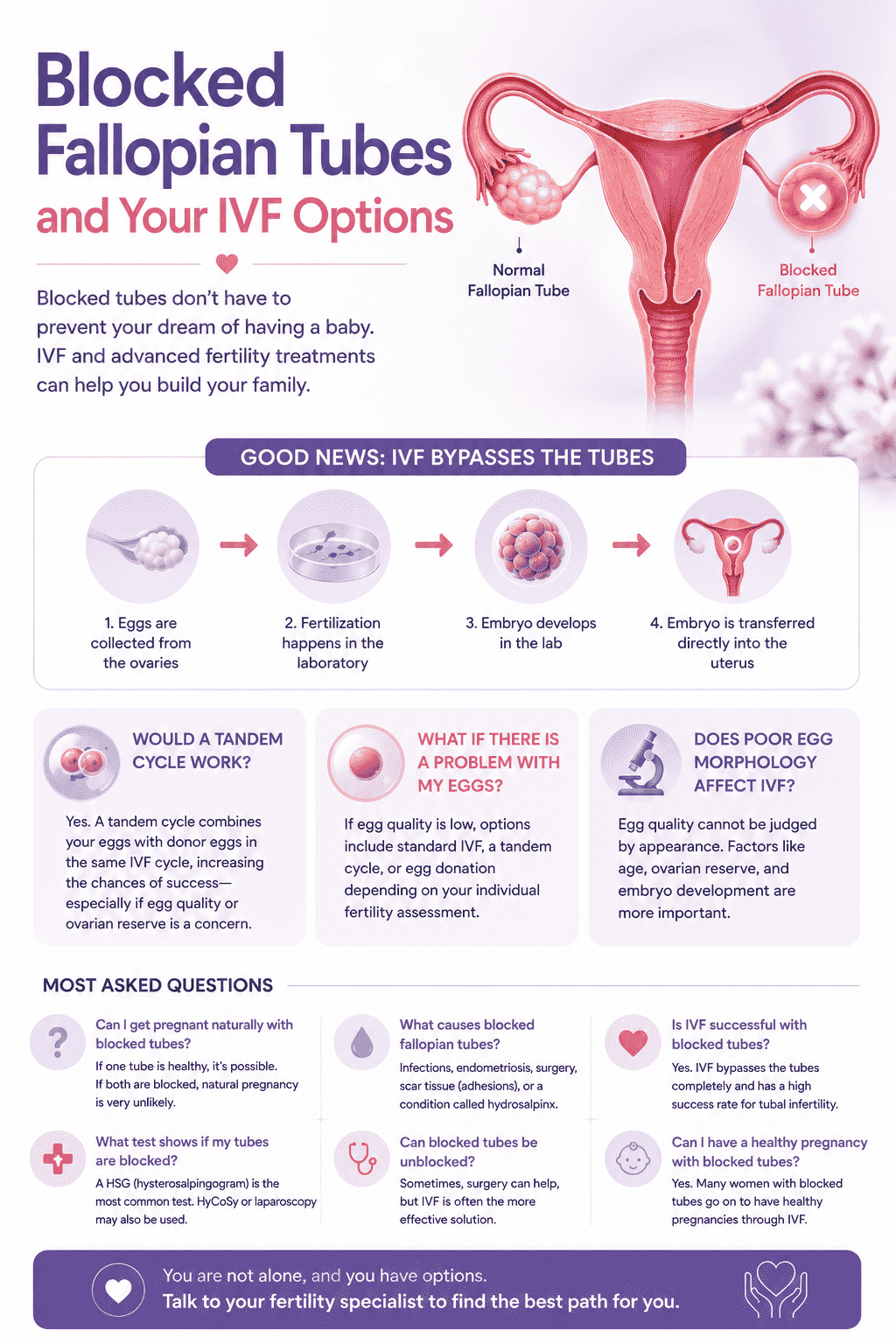
During IVF:
- Eggs are collected directly from the ovaries.
- Fertilization takes place in the laboratory.
- The embryo is transferred directly into the uterus.
Because the fallopian tubes are bypassed, many women with tubal infertility achieve successful pregnancies through IVF.
However, if a woman has a condition called hydrosalpinx, where a tube is filled with fluid, treatment of the affected tube may be recommended before embryo transfer because the fluid can reduce implantation rates.
Would a Tandem Cycle Work If My Fallopian Tubes Are Blocked?
In many cases, yes.
A tandem cycle combines a patient’s own eggs with donor eggs during the same IVF treatment.
This approach may be considered when a patient has:
- Blocked fallopian tubes
- Reduced ovarian reserve
- Poor egg quality
- Advanced maternal age
Because IVF bypasses the fallopian tubes, the blockage itself does not prevent a tandem cycle.
The decision depends more on ovarian function and the quality of the patient’s own eggs than on the condition of the tubes.
What If There Is a Problem With My Eggs?
Blocked fallopian tubes are only one part of fertility.
If testing also shows:
- Poor egg quality
- Low ovarian reserve
- Repeated abnormal embryos
- Advanced maternal age
your fertility specialist may discuss additional options.
These may include:
Standard IVF
If there are still healthy eggs available, IVF using your own eggs may remain the best option.
Tandem Cycle
Patients who still produce some eggs but have concerns about egg quality may consider combining their own eggs with donor eggs during the same treatment cycle.
This allows the opportunity for pregnancy using either source of eggs, depending on embryo development.
Egg Donation
If ovarian reserve is extremely low or egg quality has declined significantly, egg donation may offer the highest chance of achieving pregnancy.
The most appropriate option depends on your individual fertility assessment.
Does Poor Egg Morphology Affect IVF?
The word morphology is most commonly used to describe the appearance of sperm, rather than eggs.
Unlike sperm, egg quality cannot be judged by appearance alone.
Doctors evaluate egg quality using several factors, including:
- Maternal age
- Ovarian reserve
- Egg maturity
- Fertilization rates
- Embryo development
If embryo development repeatedly shows poor quality despite IVF, your fertility specialist may recommend additional testing or discuss alternative treatment options.
Can Blocked Fallopian Tubes Be Unblocked?
Sometimes.
Treatment depends on where the blockage is located and what caused it.
In selected cases, surgery may reopen a blocked tube.
However, surgery is not appropriate for everyone, and IVF is often the more effective treatment—particularly if both tubes are severely damaged or blocked.
Your fertility specialist will recommend the approach most likely to result in a healthy pregnancy.
What Test Shows If My Fallopian Tubes Are Blocked?
The most common test is a Hysterosalpingogram (HSG).
During this procedure:
- A special dye is placed inside the uterus.
- X-rays show whether the dye passes through the fallopian tubes.
Other tests that may be used include:
- HyCoSy (ultrasound with contrast)
- Laparoscopy in selected patients
These investigations help determine whether one or both tubes are blocked.
Final Thoughts
Blocked fallopian tubes are a common cause of infertility, but they are also one of the conditions for which IVF has been especially successful.
Because IVF bypasses the tubes entirely, many women with tubal infertility go on to achieve healthy pregnancies.
If blocked tubes are combined with poor ovarian reserve or concerns about egg quality, additional options such as a tandem cycle or egg donation may be discussed to maximize the chances of success.
Every fertility journey is unique.
The most important step is receiving a thorough evaluation from an experienced fertility specialist who can recommend a treatment plan based on your individual diagnosis—not just one test result.
With today’s fertility treatments, blocked fallopian tubes are no longer the obstacle they once were, and for many couples, parenthood remains very much within reach.
For any of your fertility problems, please do not hesitate to contact us. At Fertility Solutions we pride ourselves with the excellent tailored personal care we provide to our patients for their specific needs. A team member will contact you as soon as we get your message, and construct a personal treatment plan for your fertility problems in the country of Cyprus. You can also contact our clinics directly through the links below.
Get in Touch with Our Clinics:
Cyprus Crown IVF Contact: https://en.cypruscrownivf.com/contact
Cyprus American IVF Contact: https://www.cyprusamericanivf.com/contact-us/
Dr. Halil Ibrahim Tekin (Dr. HIT) Youtube: https://www.youtube.com/@dr.halilibrahimtekin1715
Cyprus American IVF Youtube: https://www.youtube.com/@AmerikanTupBebekMerkezi
Clavis Fertility Centre: https://www.clavisfertilitycenter.com