One of the most important moments during IVF treatment is the embryo transfer. However, not all embryo transfers happen at the same stage of development.
Some embryos are transferred on Day 3, while others are cultured longer and transferred on Day 5, known as a blastocyst transfer.
Today, blastocyst transfer has become one of the most widely used strategies in modern IVF because it allows doctors and embryologists to better evaluate embryo development and improve the chances of success.
But what exactly is a blastocyst, and why is Day 5 considered so important?
What Is a Blastocyst?
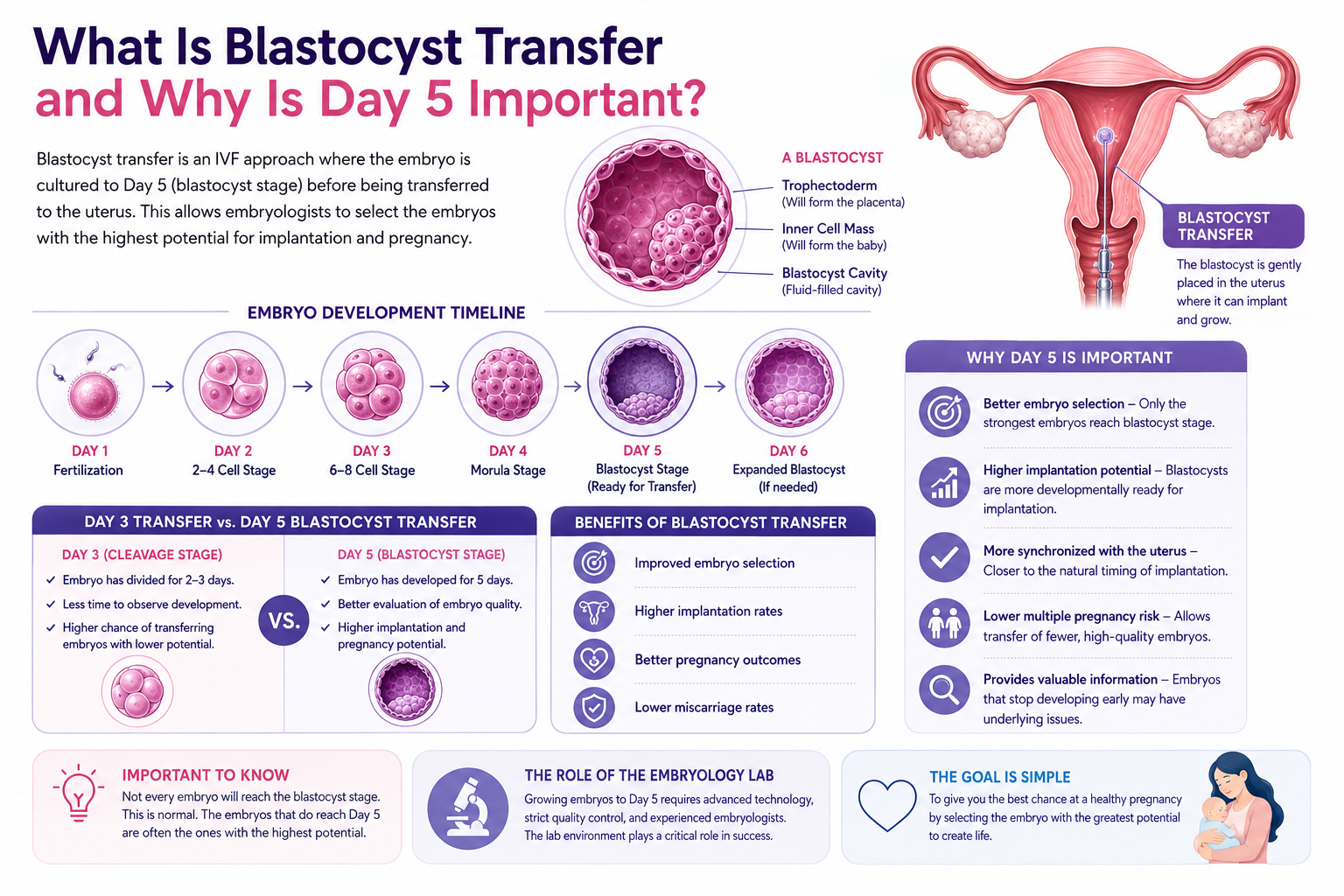
After fertilization, embryos begin dividing and developing in the laboratory.
The stages usually progress like this:
- Day 1: Fertilization occurs
- Day 2–3: Early cell division stage
- Day 5–6: Blastocyst stage
A blastocyst is a more advanced embryo that has developed into:
- An inner cell mass (which becomes the baby)
- An outer layer called the trophectoderm (which becomes the placenta)
- A fluid-filled cavity
By Day 5, the embryo has gone through several important developmental milestones.
Why Is Day 5 So Important?
Not every embryo reaches the blastocyst stage.
This is important because embryos that successfully develop to Day 5 are often considered to have:
- Better developmental potential
- Stronger implantation ability
- Higher chances of leading to pregnancy
In many ways, Day 5 acts as a natural selection process.
Embryos that stop developing before this stage may have underlying issues that would reduce implantation chances.
Blastocyst Transfer vs Day 3 Transfer
One of the most common questions patients ask is:
“Is Day 5 transfer better than Day 3?”
In many cases, yes — but it depends on the patient.
Benefits of Blastocyst Transfer
Better Embryo Selection
Allowing embryos to grow to Day 5 gives embryologists more time to observe development and identify the strongest embryos.
Higher Implantation Rates
Blastocysts are generally more synchronized with the natural timing of implantation inside the uterus.
Reduced Multiple Pregnancy Risk
Because blastocysts have higher implantation potential, clinics may transfer fewer embryos while maintaining strong success rates.
Why Some Embryos Don’t Reach Day 5
One important thing patients should understand is:
👉 It is normal for some embryos to stop developing before the blastocyst stage.
This can happen because of:
- Chromosomal abnormalities
- Egg quality issues
- Sperm DNA issues
- Natural developmental arrest
This does not always mean the IVF cycle failed — it provides valuable information about embryo quality.
Does Blastocyst Transfer Increase IVF Success?
In many patients, blastocyst transfer is associated with:
- Higher pregnancy rates
- Better implantation rates
- Improved embryo selection
However, success still depends on several factors:
- Maternal age
- Egg quality
- Sperm quality
- Uterine receptivity
- Laboratory quality
Blastocyst transfer improves selection — but it cannot completely overcome underlying biological challenges.
The Importance of the Embryology Lab
Growing embryos to Day 5 requires an advanced laboratory environment.
Embryologists must carefully control:
- Temperature
- Air quality
- Culture media
- Embryo monitoring conditions
Even small changes in the lab environment can affect embryo development.
This is why high-quality embryology labs play a critical role in successful blastocyst culture.
Fresh vs Frozen Blastocyst Transfer
Blastocysts can be transferred:
- Fresh in the same IVF cycle
- Or frozen for transfer later
In many modern IVF programs, frozen blastocyst transfers are increasingly common because they allow:
- Better hormonal preparation
- Reduced ovarian stimulation effects
- More flexibility in timing
Both approaches can achieve strong success rates depending on the patient’s situation.
Is Blastocyst Transfer Right for Everyone?
Not always.
Some patients with:
- Very few embryos
- Low ovarian reserve
- Limited embryo numbers
may still benefit from earlier transfer strategies.
The decision should always be individualized based on:
- Embryo development
- Previous IVF history
- Overall fertility factors
Final Thoughts
Blastocyst transfer represents one of the most important advances in modern IVF.
By allowing embryos to develop to Day 5, doctors and embryologists gain valuable insight into embryo quality and developmental potential.
While not every embryo reaches this stage, the ones that do often have a stronger chance of implantation and successful pregnancy.
Because in IVF, success is not simply about creating embryos — it’s about identifying the embryos with the greatest potential to create life.
For any of your fertility problems, please do not hesitate to contact us. At Fertility Solutions we pride ourselves with the excellent tailored personal care we provide to our patients for their specific needs. A team member will contact you as soon as we get your message, and construct a personal treatment plan for your fertility problems in the country of Cyprus. You can also contact our clinics directly through the links below.
Get in Touch with Our Clinics:
Cyprus Crown IVF Contact: https://en.cypruscrownivf.com/contact
Cyprus American IVF Contact: https://www.cyprusamericanivf.com/contact-us/
Dr. Halil Ibrahim Tekin (Dr. HIT) Youtube: https://www.youtube.com/@dr.halilibrahimtekin1715
Cyprus American IVF Youtube: https://www.youtube.com/@AmerikanTupBebekMerkezi
Clavis Fertility Centre: https://www.clavisfertilitycenter.com