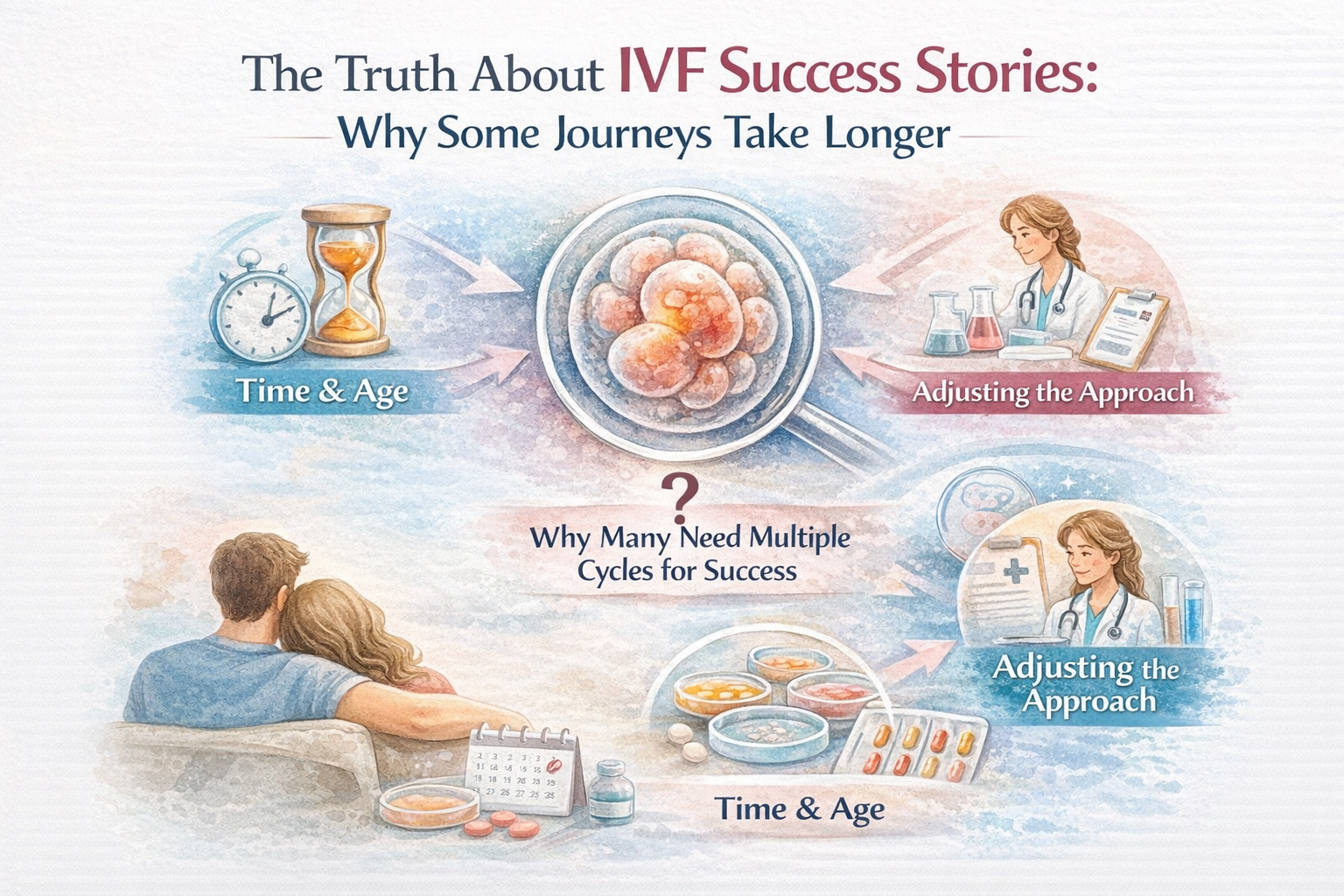
When people hear about IVF, they often focus on success stories — the happy endings, the positive pregnancy tests, and the long-awaited babies. While these stories are real and inspiring, they often leave out an important part of the journey:
Many IVF success stories do not happen on the first attempt.
For some patients, the road to pregnancy is quick. For others, it takes multiple cycles, adjustments, and time. Understanding why IVF journeys can vary so much helps set realistic expectations and reduces unnecessary emotional pressure.
IVF Is Not a One-Time Treatment
One of the biggest misconceptions about IVF is that it is a guaranteed solution.
In reality, IVF is a process, not a single event.
Each cycle provides valuable information about how the body responds to treatment. This includes:
-
How the ovaries respond to stimulation
-
How many eggs are retrieved
-
How embryos develop
-
Whether implantation occurs
Sometimes, the first cycle is more of a diagnostic cycle, helping doctors refine future treatment strategies.
Age and Egg Quality Play a Major Role
One of the most important factors influencing IVF success is age, particularly egg quality.
As women get older:
-
Egg quantity decreases
-
Chromosomal abnormalities increase
-
Embryo viability declines
This means that some patients may need multiple cycles to obtain a genetically healthy embryo.
It’s not about doing something wrong — it’s about biology.
Not Every Embryo Has the Same Potential
Even in the same IVF cycle, embryos are not equal.
Some may:
-
Develop into strong blastocysts
-
Implant successfully
-
Lead to healthy pregnancies
Others may not.
This is why IVF success often depends on finding the right embryo, not just creating embryos.
In some cases, it takes more than one cycle to achieve that.
The Uterus and Timing Matter
Implantation is one of the most delicate steps in IVF.
Even with a healthy embryo, success depends on:
-
Proper timing of embryo transfer
-
Uterine receptivity
-
Hormonal balance
If these factors are slightly off, implantation may fail.
In later cycles, doctors may adjust:
-
Transfer timing
-
Medication protocols
-
Preparation of the uterine lining
Small changes can make a significant difference.
Hidden Factors May Require Investigation
When IVF does not succeed after one or two attempts, deeper investigation may be needed.
These may include:
-
Genetic testing of embryos
-
Uterine evaluation
-
Immune-related factors
-
Sperm DNA quality
Each unsuccessful cycle helps narrow down possible causes and guide a more personalized approach.
Emotional Pressure Can Be Misleading
Many patients compare themselves to others who became pregnant quickly through IVF.
This comparison can create unnecessary stress.
The truth is:
-
Every fertility journey is different
-
Success timelines vary widely
-
One patient’s experience does not define another’s
Social media and online stories often highlight the final result — not the full journey behind it.
Success Often Comes After Adjustment
In many cases, IVF success happens after refining the approach.
This may include:
-
Changing stimulation protocols
-
Improving embryo selection
-
Using genetic testing
-
Exploring alternative treatments
Rather than repeating the same method, modern fertility care focuses on adapting the strategy based on previous outcomes.
The Importance of Persistence and Strategy
While persistence is important, it must be combined with the right medical strategy.
Repeating identical cycles without adjustment may not improve outcomes. However, adjusting the treatment plan based on new information can significantly increase the chances of success.
Many successful IVF stories are the result of:
-
Multiple attempts
-
Careful evaluation
-
Personalized treatment
Final Thoughts
IVF success stories are real — but they are often more complex than they appear.
Behind many positive outcomes are cycles of learning, adjustment, and perseverance. For some patients, success comes quickly. For others, it takes time and a tailored approach.
Understanding this reality helps shift the perspective from “Why didn’t it work?” to “What can we learn and improve next?”
Because in IVF, success is not always about the first attempt.
Sometimes, it’s about finding the right path — even if it takes a little longer to get there.
For any of your fertility problems, please do not hesitate to contact us. At Fertility Solutions we pride ourselves with the excellent tailored personal care we provide to our patients for their specific needs. A team member will contact you as soon as we get your message, and construct a personal treatment plan for your fertility problems in the country of Cyprus. You can also contact our clinics directly through the links below.
Get in Touch with Our Clinics:
Cyprus Crown IVF Contact: https://en.cypruscrownivf.com/contact
Cyprus American IVF Contact: https://www.cyprusamericanivf.com/contact-us/
Dr. Halil Ibrahim Tekin (Dr. HIT) Youtube: https://www.youtube.com/@dr.halilibrahimtekin1715
Cyprus American IVF Youtube: https://www.youtube.com/@AmerikanTupBebekMerkezi
Clavis Fertility Centre: https://www.clavisfertilitycenter.com